Preprint · not peer-reviewed
Agricultural AI Agents Can Learn from Chemical Complex System Models
2026
Abstract
Smart farms and plant factories increasingly use sensors, automatic controllers, digital twins, and artificial intelligence models. However, nutrient management remains difficult because nutrient solutions are nonlinear chemical systems coupled with plant uptake dynamics. This paper proposes a simulation-first strategy for smart-farm nutrient management agents. The proposed strategy is grounded in previous studies on ion-selective electrode correction, ODE network modeling of nutrient solutions, plant-root ion transport, nutrient-plant interaction simulation, automated nutrient-solution management systems, and plant-factory digital twins. The paper further proposes a three-layer digital-twin interpretation consisting of facility-level, crop-level, and nutrient-control digital twins. The nutrient-control digital twin is positioned as a chemical-physiological playground inside a broader plant-factory digital twin. The proposed approach does not require sub-second real-time agent control because nutrient uptake and nutrient-related physiological responses are evaluated over multi-minute, hourly, daily, or crop-stage timescales. Therefore, nutrient management agents should be introduced as supervisory simulators and target-profile optimizers rather than direct dosing robots.
Keywords: agricultural AI agent, nutrient management, smart farm, plant factory, chemical complex system, nutrient solution, ion-selective electrode, digital twin, plant uptake, simulation-first control
1. Introduction
Smart farms and plant factories are increasingly equipped with sensors, controllers, cameras, nutrient-solution management systems, digital twins, and artificial intelligence models. These systems can measure environmental variables, monitor crop growth, estimate plant status, detect stress, and control irrigation or nutrient supply. However, nutrient management remains one of the most difficult parts of smart-farm operation because the root-zone environment is both chemically complex and biologically coupled to plant uptake.
Traditional hydroponic nutrient management often relies on pH and electrical conductivity (EC). When EC decreases, concentrated nutrient solution is added to recover total ionic strength. This method is simple but insufficient because EC cannot represent the balance of individual ions. Even if total EC appears normal, the ratio of nitrate, potassium, calcium, magnesium, ammonium, phosphate, and other ions may deviate from the desired composition. This is especially problematic in closed hydroponic systems, where plants absorb different ions at different rates and the remaining solution gradually changes composition.
Previous studies have already shown the importance of individual ion monitoring and ion-specific management in closed hydroponic systems. ISE-based systems can measure individual ions such as nitrate, potassium, and calcium, and closed hydroponic nutrient management increasingly emphasizes ion balance rather than EC alone [8-10]. Ban and collaborators addressed this problem through a sequence of nutrient-solution studies: machine-learning correction of ion interference [1], ODE network modeling of nutrient-solution chemistry [2], mathematical modeling of root cation transport [3], nutrient-plant interaction simulation [4], deep-learning-based artifact removal for ISEs [5], and automated nutrient-solution management for smart farms and plant factories [6].
This paper extends that research line by proposing a simulation-first nutrient management agent. The central argument is that an agricultural AI agent should not directly translate nutrient-sensor deviations into actuator commands. Instead, it should first correct sensor artifacts, estimate the nutrient state, simulate candidate interventions in a chemical-and-plant uptake playground, evaluate the risk of ion accumulation or uptake inhibition, and only then update the target profile of the real nutrient controller.
The title phrase "AI agents can learn from chemical complex system models" is clarified as follows. In this paper, "learning" does not necessarily mean end-to-end neural training. It includes three operational modes:
1. Simulation-based planning, where the agent tests candidate nutrient-control inputs before applying them.
2. Synthetic trajectory generation, where the model produces state-action-outcome trajectories that can be used to train or evaluate decision policies.
3. Risk-aware recommendation, where the agent uses simulated outcomes to avoid unsafe nutrient-control decisions.
Thus, the proposed agent is not a direct dosing robot. It is a supervisory system that uses a chemical complex system model as a playground before updating nutrient-control parameters.
2. Related Work: Nutrient-Solution and Digital-Twin Research
2.1 ISE correction for reliable nutrient observation
Ion-selective electrodes (ISEs) can estimate individual ion concentrations, but they are affected by ion interference, drift, kinetic artifacts, and electrical artifacts. Ban, Ryu, and Lee proposed a machine-learning approach to remove ion interference effects in agricultural nutrient solutions [1]. This work is important for nutrient management agents because an agent cannot safely reason about nutrient control if its input state is distorted by sensor artifacts.
A later study extended this direction by using deep learning to remove chemical, kinetic, and electric artifacts on ISEs [5]. Chemical artifacts arise from ion interference in mixed solutions, kinetic artifacts can occur due to liquid movement, and electric artifacts can occur when multiple electrodes interact in the same solution. In an agent architecture, these studies form the sensor-correction layer. The agent should observe a corrected nutrient state rather than raw ISE readings.
2.2 ODE network model for nutrient-solution complex chemistry
The ODE network model proposed by Ban, Lee, and Ryu is the core foundation for a simulation-first nutrient management agent [2]. In that work, nutrient solution is treated as a nonlinear complex system containing precipitation reactions and complicated interactions. The model describes chemical reactions through differential equations and predicts molar concentrations of chemical components and total dissolved solids. It can also calculate required chemical compound inputs from desired dissolved ion concentrations.
This is the exact type of model that an agricultural AI agent can use as a playground. Instead of directly applying a nutrient-control input to a real tank, the agent can first simulate how the candidate input may change ion concentrations, EC, pH, total dissolved solids, precipitation risk, and long-term ion balance.
2.3 Mathematical modeling of plant-root ion transport
A nutrient solution does not evolve only through chemistry. It also changes because plants absorb ions. Ban’s mathematical model for secondary transport of cations at plant roots describes root-cell ion transport through active H+ emission, electrical gradient formation, and cation movement [3]. This work provides a conceptual bridge between the chemical state of the solution and the physiological uptake process of the plant.
For a nutrient management agent, this is critical. If the agent only models solution chemistry, it may predict the immediate chemical consequence of dosing but fail to predict how the plant will gradually remove or fail to remove certain ions. Therefore, a simulation playground should include both nutrient-solution chemistry and plant uptake dynamics.
2.4 Nutrient-plant interaction simulation
Ban’s nutrient-plant interaction simulation study combines differential-equation models of nutrient solution and plant interaction [4]. This work is especially relevant because it moves from solution-only modeling toward a coupled system in which nutrient state and plant uptake affect each other. In this paper, that coupled model is interpreted as a nutrient-control digital twin component. It does not need to represent every morphological detail of plant growth. Instead, it provides a dynamic simulation layer for root-zone nutrient behavior and plant uptake response.
2.5 Automated nutrient-solution management system
The Nutrient Solution Management System for Smart Farms and Plant Factory connects the modeling and sensing research line to practical management [6]. It proposes an automated nutrient solution system that measures individual ions, supports calibration, and adds insufficient nutrients rather than simply adding concentrated solution based on EC.
In the present paper, this system represents the real controller layer. The AI agent does not need to directly actuate pumps. Instead, it can update the target ion profile, dosing policy, or control parameters that such a nutrient-management device follows.
2.6 Plant-factory digital twins
Ban’s Mixed Reality Interface for Digital Twin of Plant Factory proposed an immersive and interactive mixed-reality interface for plant-factory digital twin models [7]. The paper describes a real-time camera-based background scene and an interface through which users can monitor and control remote plant factory facilities using an HMD or 2D display.
This establishes that a digital-twin concept for plant-factory operation has already been proposed. However, the present paper does not claim that a nutrient chemical playground is identical to a full facility-level digital twin. Instead, it proposes that nutrient-solution chemistry and plant uptake dynamics can become a specialized nutrient-control digital twin module inside a broader smart-farm or plant-factory digital twin environment.
3. Clarifying “Learning from Chemical Complex System Models”
The expression “learning from chemical complex system models” can be interpreted in multiple ways. To avoid ambiguity, this paper defines three levels of model use.
3.1 Simulation-based planning
At the simplest level, the agent uses the chemical complex system model for planning. The agent generates candidate nutrient-control inputs, simulates them, compares predicted outcomes, and chooses a safer option. This does not require training a new neural network. It is model-based decision support.
3.2 Synthetic trajectory generation
At a stronger level, the model can generate synthetic trajectories. These trajectories may include:
current nutrient state → candidate target profile → predicted ion trajectory → risk score → recommended action
Such trajectories can be used to train, fine-tune, or benchmark nutrient-management policies. In this sense, the chemical complex system model becomes a data-generating environment for the agent.
3.3 Risk-aware recommendation
At the operational level, the agent learns which proposals are unsafe by repeatedly evaluating simulation outcomes. For example, if a candidate update repeatedly produces slow-ion accumulation, high osmotic load, or ion antagonism risk, the agent can learn to avoid such updates or request additional verification before recommending them.
Thus, “learning” in this paper includes direct model-based planning, simulated experience generation, and risk-aware policy shaping. The core claim is not that the agent must be trained only by deep reinforcement learning. The core claim is that the agent should not make nutrient-control decisions without first consulting a chemical-physiological simulation environment.
4. Biological and Chemical Design Assumptions
4.1 Nutrient uptake is not a sub-second control problem
Unlike low-level motor control, plant nutrient uptake is a relatively slow biological process. Changes in ion concentration, root-zone equilibrium, plant uptake, and physiological response usually occur over multi-minute, hourly, daily, or crop-stage timescales. Root ion uptake kinetics are known to vary across plant species, cultivars, developmental stages, root types, and environmental conditions [11]. Therefore, a nutrient management agent does not need to operate as a sub-second real-time controller.
This latency tolerance changes the role of the AI agent. The agent should not directly send immediate pump commands. Instead, it can afford to simulate several candidate nutrient-control strategies, compare their predicted outcomes, evaluate risks, and then update the target profile of an existing nutrient controller. The physical controller can continue to execute real-time or near-real-time dosing logic, while the agent changes the supervisory direction of nutrient management.
4.2 Fast-uptake ions and recoverable oversupply
Different ions are absorbed at different rates, and these rates are not universal constants. They depend on crop species, cultivar, growth stage, root-zone condition, transporter activity, temperature, pH, and external ion concentration [11]. Therefore, this paper does not claim a fixed universal list of “fast” or “slow” ions.
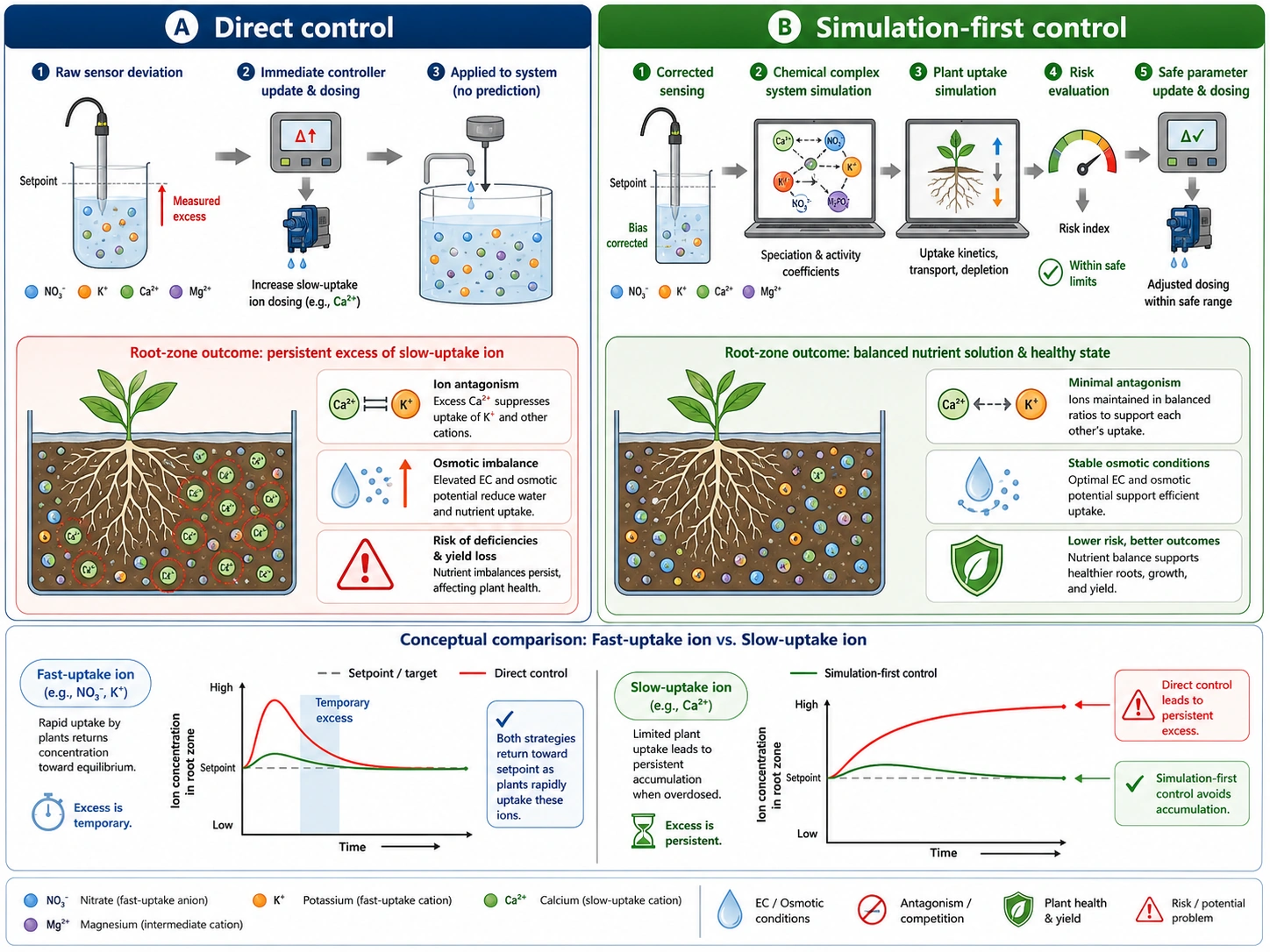
Instead, this paper proposes an agent design assumption: if an ion has a high estimated uptake rate under the current crop and root-zone condition, moderate oversupply may be more recoverable because plants can reduce the excess more quickly. This assumption must remain bounded by toxicity, antagonism, osmotic stress, and recipe constraints. It should be treated as a risk-aware policy heuristic, not as a universal physiological law.
4.3 Slow-uptake ions and persistent imbalance
For ions with low estimated uptake rates under the current condition, oversupply may persist in the nutrient solution. Persistent excess can increase ionic activity, ionic strength, osmotic pressure, and electrochemical imbalance. Elevated EC in the root environment can create osmotic stress and impede water uptake, and excessive nutrient concentration can negatively affect plant growth and metabolism [15].
This is the key reason why simulation-first nutrient control is needed. A direct control system that simply reacts to current deficiency may add an ion without considering whether another slowly absorbed ion will accumulate and later disturb uptake balance. A chemical-and-plant uptake playground can evaluate this risk before the real nutrient controller is updated.
4.4 Ion antagonism and transport disruption as risk factors
Ion uptake is not independent. Nutrient interactions can be antagonistic or synergistic, and excessive supply of one nutrient may interfere with uptake or utilization of another [13,14]. For example, K-Mg antagonism is a well-known nutrient interaction, and K-induced Mg deficiency has been widely discussed in plant nutrition [13].
This paper treats such interactions as risk factors rather than fully solved physiological equations. The proposed agent should not claim perfect causal knowledge of all transporter-level mechanisms. Instead, it should evaluate whether a candidate nutrient-profile update increases the risk of antagonism, osmotic imbalance, or transport disruption.
Secondary active transport is also relevant because plant membrane transporters can be driven by proton motive force and electrochemical gradients [12]. If the nutrient solution becomes severely imbalanced, the agent should treat possible disruption of electrochemical conditions as a risk signal. This does not mean the model perfectly predicts every transporter event. It means the agent should avoid nutrient-control actions that push the root-zone state toward conditions known to be physiologically risky.
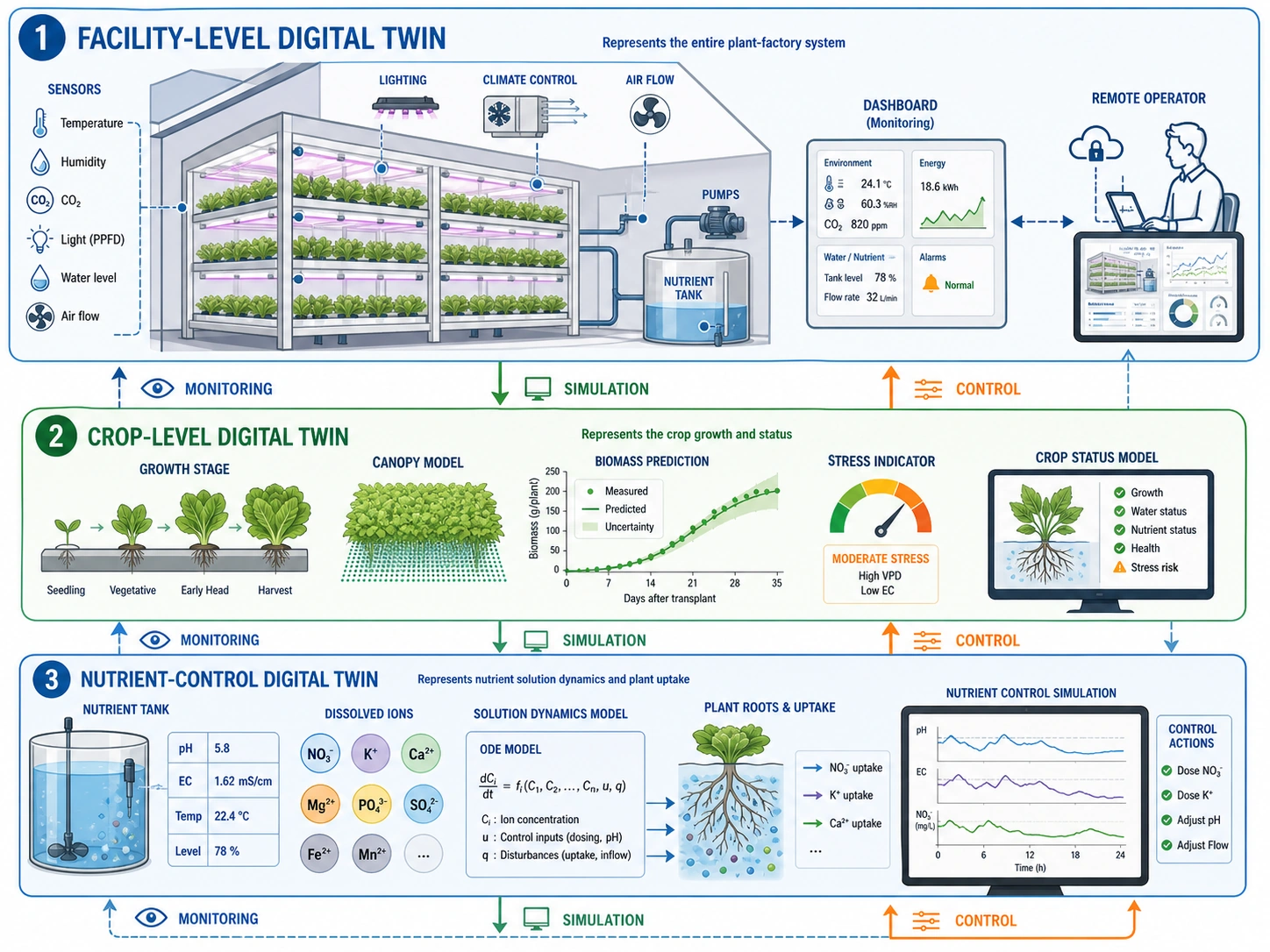
5. Three-Layer Digital-Twin Interpretation
5.1 Facility-level digital twin
A facility-level digital twin represents the physical plant factory or smart farm. It includes racks, tanks, pumps, sensors, cameras, controllers, lighting systems, HVAC systems, irrigation systems, and user interfaces. Ban’s mixed-reality plant-factory digital twin work belongs mainly to this level [7]. It supports remote monitoring and control through an interactive interface.
5.2 Crop-level digital twin
A crop-level digital twin represents plant state. It may include growth stage, biomass, canopy area, root status, stress risk, nutrient demand, and harvest readiness. In plant factories, this layer can be informed by machine vision, crop growth models, and environmental histories.
5.3 Nutrient-control digital twin
A nutrient-control digital twin represents root-zone chemistry and nutrient uptake dynamics. It includes ion concentrations, EC, pH, TDS, ion activity, precipitation risk, dosing history, uptake-rate parameters, and plant-nutrient interaction models.
The present paper proposes this third layer. It does not replace the facility-level digital twin. Instead, it can be embedded inside a broader plant-factory digital twin as a chemical-physiological simulation module. In this sense, a chemical complex system model becomes a nutrient-control playground for agricultural AI agents.
6. Chemical Complex System Models as Agent Playgrounds
6.1 Definition of a nutrient-control playground
In this paper, a nutrient-control playground is defined as a simulation environment in which an agricultural AI agent can test candidate nutrient-control inputs before updating a real nutrient controller. The playground does not directly drive pumps or valves. It predicts possible outcomes of target-profile changes, recipe changes, or dosing-policy changes.
The playground consists of three components:
1. A corrected nutrient-state estimator.
2. A chemical complex system model of nutrient solution.
3. A plant uptake and nutrient-plant interaction model.
Together, these components allow the agent to ask: “If I update the target nitrate, potassium, calcium, magnesium, or pH profile in this way, what chemical and physiological consequences are expected?”
6.2 State variables
A nutrient-control playground should include the following state variables:
- pH
- EC
- total dissolved solids
- individual ion concentrations
- estimated ion activity
- ionic strength
- root-zone temperature
- nutrient tank volume
- recent dosing history
- crop species
- crop growth stage
- estimated uptake-rate parameters
- sensor calibration state
- sensor confidence score
- digital-twin state
Sensor confidence is important because the agent should not treat all measurements equally. If ISE correction tools indicate low confidence, the agent should avoid aggressive target-profile updates.
6.3 Candidate actions
The agent can test candidate actions such as:
- update nitrate target concentration
- update potassium target concentration
- update calcium target concentration
- update magnesium target concentration
- adjust pH target
- adjust EC target
- change dilution ratio
- change dosing interval
- change nutrient recipe by crop stage
- change allowable deviation threshold
These are not direct actuator commands. They are supervisory nutrient-control candidates that may later be translated into controller parameters.
6.4 Simulation outputs
The playground should return outputs such as:
- predicted ion concentration trajectory
- predicted pH and EC trajectory
- precipitation risk
- slow-ion accumulation risk
- ion antagonism risk
- osmotic imbalance risk
- secondary active transport disruption risk
- target-profile feasibility
- recommended safe update
- uncertainty score
These outputs allow the agent to compare candidate policies before interacting with the real nutrient-management device.
7. Proposed Architecture for Smart-Farm Nutrient Management Agents
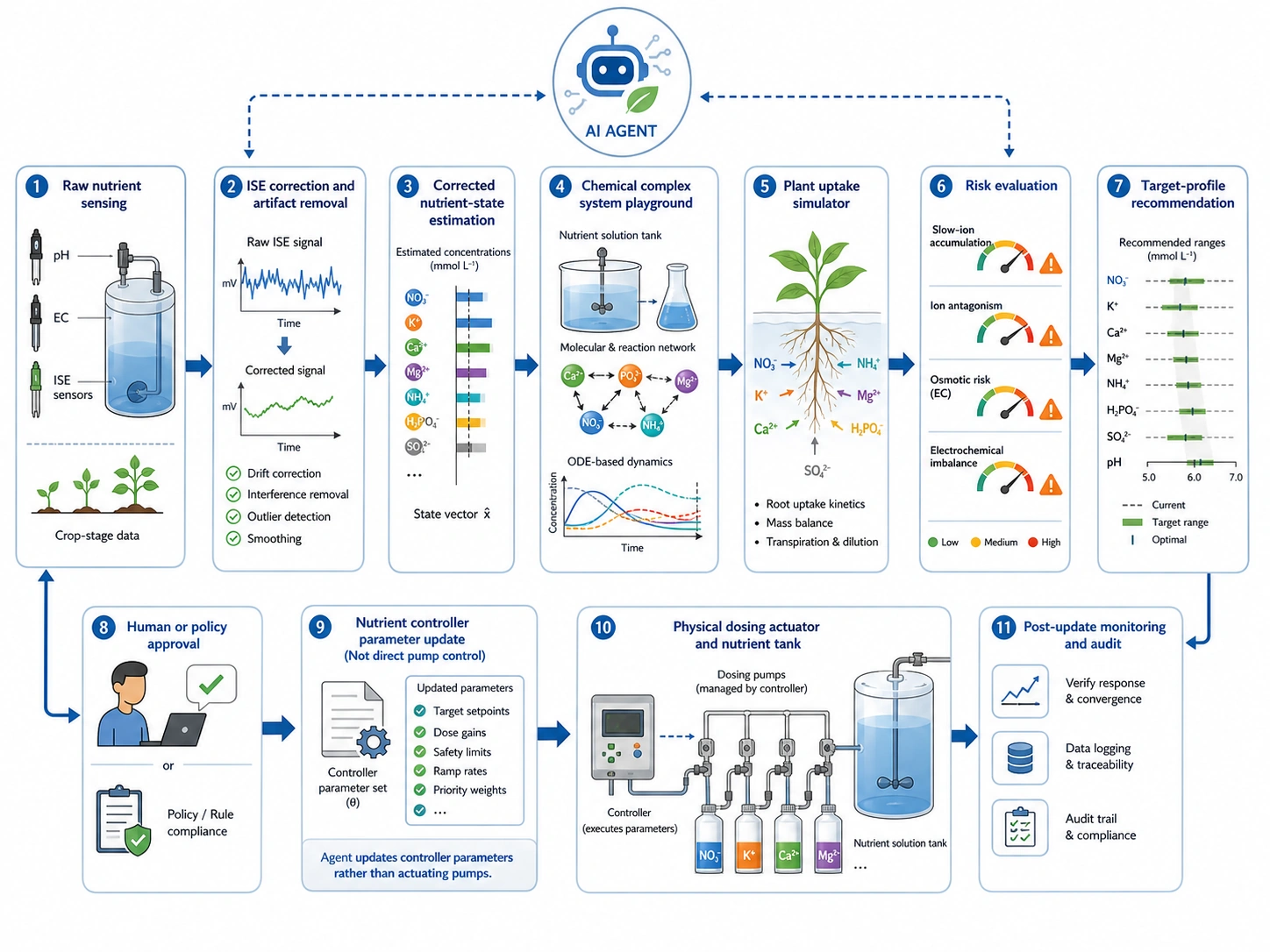
The proposed architecture is shown conceptually below.
Raw nutrient sensing
↓
ISE correction and artifact removal
↓
Corrected nutrient-state estimation
↓
Chemical complex system playground
↓
Plant uptake simulator
↓
Risk evaluation
↓
Target-profile recommendation
↓
Human or policy approval
↓
Nutrient controller parameter update
↓
Physical dosing actuator
↓
Post-update monitoring and audit
7.1 Observation layer
The observation layer collects pH, EC, ISE data, temperature, tank volume, dosing history, and crop-stage information. Raw ISE data are corrected using interference-removal and artifact-removal models [1,5].
7.2 Simulation layer
The simulation layer uses the ODE nutrient-solution model and plant uptake model [2-4]. Candidate target-profile updates are tested in this model before any real controller parameter is changed.
7.3 Decision layer
The decision layer evaluates candidate actions using risk criteria. It should penalize slow-ion accumulation, ion antagonism, excessive osmotic pressure, and predicted disruption of root-zone electrochemical balance.
7.4 Controller interface layer
The agent does not directly actuate pumps. Instead, it updates the target profile or policy parameters of the nutrient controller. The controller then determines actual dosing amounts, pump timing, mixing, calibration, and safety cutoffs.
7.5 Digital-twin interface layer
The chemical playground can be integrated into a broader plant-factory digital twin. Ban’s plant-factory digital twin interface already proposed that remote plant-factory facilities can be monitored and controlled through an interactive mixed-reality environment [7]. The nutrient-control playground can serve as a specialized chemical-physiological module inside such a digital twin.
8. Risk-Aware Nutrient Control Policy
8.1 Ion uptake-rate classes
A nutrient management agent should classify ions by estimated uptake behavior and persistence risk. This classification should not be fixed universally. It should be estimated for each crop species, cultivar, growth stage, root-zone condition, and sensor-confidence level.
| Ion class | Description | Agent policy |
|---|---|---|
| Fast-uptake under current condition | Moderate excess is likely to be reduced relatively quickly by plant uptake | Allow small temporary overshoot only within safe and non-antagonistic bounds |
| Medium-uptake under current condition | Correction requires controlled adjustment | Simulate before updating target profile |
| Slow-uptake under current condition | Excess may persist and disturb ion balance | Use strict upper bounds and accumulation penalties |
| Antagonism-risk ion | Excess may inhibit uptake of another ion | Evaluate interaction risk before update |
| Uncertain ion | Sensor confidence or uptake parameter is uncertain | Avoid aggressive updates and request verification |
8.2 Slow-ion penalty
A conceptual risk score can be defined as:
Risk_slow_ion =
accumulation_persistence
× uptake_competition
× osmotic_impact
× electrochemical_imbalance
× sensor_uncertainty
This is not proposed as a final universal equation. It is a design principle for agentic nutrient control. The point is that a nutrient management agent should not only minimize instantaneous deviation from target concentration. It should minimize future risk caused by persistent imbalance.
8.3 Simulation-first decision rule
A safe nutrient management agent should follow this rule:
Do not update a real nutrient-controller target profile
until candidate updates have been simulated
for chemical feasibility, uptake dynamics,
slow-ion accumulation, ion antagonism,
and osmotic/electrochemical risk.
This rule is especially important in closed hydroponic systems, where incorrect nutrient additions can remain in the system and affect later uptake.
9. Agent Workflow
The proposed nutrient management workflow is as follows.
Step 1. Observe corrected nutrient state
The agent reads corrected pH, EC, ISE-derived ion concentrations, sensor confidence, crop stage, and dosing history.
Step 2. Diagnose imbalance
The agent compares the current nutrient state with the crop-stage target profile.
Step 3. Generate candidate nutrient-control inputs
The agent proposes several candidate profile updates, not direct dosing commands.
Step 4. Simulate chemical response
The agent runs the ODE-based chemical complex system model to predict chemical trajectories.
Step 5. Simulate plant uptake response
The agent evaluates how the plant may absorb or fail to absorb each ion over time.
Step 6. Evaluate risk
The agent estimates precipitation risk, slow-ion accumulation risk, osmotic imbalance, ion antagonism, and possible transport-disruption risk.
Step 7. Select safe target profile
The agent chooses a conservative target-profile update that minimizes both deficiency and long-term imbalance.
Step 8. Update nutrient controller parameters
After human or policy approval, the agent updates the target profile of the existing nutrient controller.
Step 9. Monitor post-update trajectory
The agent checks whether measured ion concentrations follow the predicted trajectory.
Step 10. Audit decision and outcome
The agent records sensor state, simulation results, selected profile, approval, controller update, and post-update outcome.
10. Discussion
10.1 Why simulation-first control is safer than direct nutrient control
Direct nutrient control is risky because nutrient solutions are nonlinear chemical systems and plant uptake is delayed. A sensor deviation does not necessarily imply that a simple dosing action is safe. The agent must consider precipitation, ion interaction, pH and EC drift, osmotic load, and uptake competition. Simulation-first control reduces the risk of making slow-to-correct changes to the nutrient solution.
10.2 Why latency is acceptable
In many agricultural AI applications, latency is a weakness. In nutrient management, moderate decision latency can be acceptable because plant nutrient uptake and physiological responses are not sub-second processes. This makes it feasible for an agent to spend time correcting sensor data, simulating candidate actions, and comparing risk before updating the nutrient controller.
10.3 Chemical complex models as learning environments
Chemical complex system models can serve as learning environments for agricultural AI agents. The agent can learn which nutrient-control candidates are chemically feasible, which ones create persistent imbalance, and which ones are likely to be corrected by plant uptake. This learning can be explicit through simulation-based planning or implicit through training policies on simulated trajectories.
10.4 Digital twins for plant growth and nutrient control
Plant-factory digital twins have already been proposed for remote monitoring and control [7]. The present paper extends that concept by emphasizing nutrient-solution chemistry and plant uptake dynamics as internal simulation modules of a digital twin. A plant-growth digital twin should not only display canopy images or environmental dashboards. It should also simulate root-zone chemistry, nutrient uptake, and the consequences of target-profile updates.
10.5 Limitations
This paper is a design-strategy paper. It does not present a new calibrated crop-specific uptake model, a real deployment, or experimental validation. The proposed architecture depends on accurate sensor correction, reliable chemical modeling, cultivar-specific uptake parameters, and robust controller integration. Future work should evaluate the architecture in real smart-farm and plant-factory systems.
11. Conclusion
This paper proposed a simulation-first strategy for smart-farm nutrient management agents. The central argument is that agricultural AI agents can learn from chemical complex system models and use them as playgrounds before changing real nutrient-control parameters. Here, “learning” means simulation-based planning, synthetic trajectory generation, and risk-aware recommendation rather than necessarily end-to-end neural training.
The agent should not directly translate pH, EC, or raw ISE deviations into actuator commands. Instead, it should correct sensor artifacts, estimate nutrient state, simulate candidate target-profile updates, evaluate chemical and physiological risks, and then update the nutrient controller only when the predicted outcome is safe.
Previous researches on nutrient solution management and modeling provides a foundation for this strategy: ISE correction enables reliable observation, ODE network modeling provides a chemical complex system playground, root ion transport modeling explains plant uptake dynamics, nutrient-plant interaction simulation connects chemistry and physiology, and automated nutrient-solution management systems provide a real controller interface [1-6]. Ban’s plant-factory digital twin work further shows that smart-farm operation can be represented through digital-twin environments [7]. The present paper connects these ideas into a nutrient management agent architecture.
The key practical implication is that nutrient management agents should be introduced as supervisory simulation systems, not as direct dosing robots. They should update target profiles, recipes, thresholds, and dosing policies after simulation and approval, while existing nutrient controllers perform the physical dosing and safety enforcement. This approach is particularly important for avoiding persistent accumulation of slow-uptake ions, which may disturb ionic activity, osmotic balance, electrochemical gradients, and nutrient uptake interactions.
References
[1] Ban, B.; Ryu, D.; Lee, M. Machine Learning Approach to Remove Ion Interference Effect in Agricultural Nutrient Solutions. International Conference on Information and Communication Technology Convergence, 2019, 1156-1161. doi: 10.1109/ICTC46691.2019.8939812.
[2] Ban, B.; Lee, M.; Ryu, D. ODE Network Model for Nonlinear and Complex Agricultural Nutrient Solution System. International Conference on Information and Communication Technology Convergence, 2019, 996-1001. doi: 10.1109/ICTC46691.2019.8939946.
[3] Ban, B. Mathematical Model for Secondary Transport of Cations at the Root of Plants. Preprints, 2019, 2019090219. doi: 10.20944/preprints201909.0219.v1.
[4] Ban, B. Mathematical Model and Simulation for Nutrient-Plant Interaction Analysis. International Conference on Information and Communication Technology Convergence, 2020, 1531-1536. doi: 10.1109/ICTC49870.2020.9289083.
[5] Ban, B.; Ryu, D.; Lee, M. Deep Learning Method to Remove Chemical, Kinetic and Electric Artifacts on ISEs. International Conference on Information and Communication Technology Convergence, 2020, 1242-1246; Preprints, 2020, 2020050381. doi: 10.20944/preprints202005.0381.v2.
[6] Ban, B.; Lee, J.; Ryu, D.; Lee, M.; Eom, T. D. Nutrient Solution Management System for Smart Farms and Plant Factory. International Conference on Information and Communication Technology Convergence, 2020, 1537-1542. doi: 10.1109/ICTC49870.2020.9289192.
[7] Ban, B. Mixed Reality Interface for Digital Twin of Plant Factory. arXiv, 2022, arXiv:2211.00597. doi: 10.48550/arXiv.2211.00597.
[8] Cho, W.-J.; Kim, H.-J.; Jung, D.-H.; Kim, D.-W.; Ahn, T. I.; Son, J.-E. On-Site Ion Monitoring System for Precision Hydroponic Nutrient Management. Computers and Electronics in Agriculture, 2018, 146, 51-58. doi: 10.1016/j.compag.2018.01.019.
[9] Richa, A.; Fizir, M.; Touil, S. Advanced Monitoring of Hydroponic Solutions Using Ion-Selective Electrodes and the Internet of Things: A Review. Environmental Chemistry Letters, 2021, 19, 3445-3463. doi: 10.1007/s10311-021-01233-8.
[10] Cho, W.-J.; Kim, H.-J.; Jung, D.-H.; et al. Decision-Tree-Based Ion-Specific Dosing Algorithm for Enhancing Closed Hydroponic Efficiency and Reducing Carbon Emissions. Frontiers in Plant Science, 2023, 14, 1301490. doi: 10.3389/fpls.2023.1301490.
[11] Griffiths, M.; York, L. M. Targeting Root Ion Uptake Kinetics to Increase Plant Productivity and Nutrient Use Efficiency. Plant Physiology, 2020, 182(4), 1854-1868. doi: 10.1104/pp.19.01496.
[12] Andersen, C. G.; Bavnhøj, L.; Pedersen, B. P. May the Proton Motive Force Be with You: A Plant Transporter Review. Current Opinion in Structural Biology, 2023, 79, 102535. doi: 10.1016/j.sbi.2023.102535.
[13] Xie, K.; Cakmak, I.; Wang, S.; Zhang, F.; Guo, S. Synergistic and Antagonistic Interactions between Potassium and Magnesium in Higher Plants. The Crop Journal, 2021, 9(2), 249-256. doi: 10.1016/j.cj.2020.10.005.
[14] Rietra, R. P. J. J.; Heinen, M.; Dimkpa, C. O.; Bindraban, P. S. Effects of Nutrient Antagonism and Synergism on Yield and Fertilizer Use Efficiency. Communications in Soil Science and Plant Analysis, 2017, 48(16), 1895-1920. doi: 10.1080/00103624.2017.1407429.
[15] He, L.; et al. The Impact of Nutrient Solution Electrical Conductivity on Leaf Transcriptome Contributing to the Fruit Quality of Cucumber Grown in Coir Cultivation. International Journal of Molecular Sciences, 2024, 25, 11984. doi: 10.3390/ijms252211984.
[16] Zhang, Z.; Zhu, Z.; Gao, G.; Qu, D.; Zhong, J.; Jia, D.; Du, X.; Yang, X.; Pan, S. Design and Research of Digital Twin System for Multi-Environmental Variable Mapping in Plant Factory. Computers and Electronics in Agriculture, 2023, 213, 108243. doi: 10.1016/j.compag.2023.108243.
Citation
형식을 누르면 인용 정보가 복사됩니다.