Preprint · not peer-reviewed
Artificial Intelligence Technologies in Plant Factories over the Last Decade: Machine Vision, Nutrient Intelligence, Control, and Digital Twins
2026
Abstract
Plant factories have evolved from automated cultivation facilities into data-driven crop production systems. Over the last decade, artificial intelligence has been applied to non-destructive crop monitoring, sensor correction, nutrient-solution diagnosis, growth prediction, environmental control, digital twins, and product-level inspection. This review summarizes AI technologies for plant factories, focusing on machine vision, deep learning, nutrient-solution intelligence, reinforcement learning, and digital-twin interfaces. The main argument is that plant-factory AI should not be understood only as image-based phenotyping; practical systems require an integrated intelligence stack connecting visual perception, sensor calibration, nutrient modeling, control, remote operation, and industrial inspection. Remaining challenges include dataset scarcity, model generalization, sensor drift, explainability, energy-aware control, and closed-loop decision-making.
Keywords: plant factory, artificial intelligence, PFAL, vertical farming, machine vision, deep learning, nutrient solution, ion-selective electrode, digital twin, reinforcement learning
1. Introduction
Plant factories are controlled-environment agricultural systems in which crop growth is managed through artificial regulation of light, temperature, humidity, carbon dioxide, airflow, water, and nutrient solution. In plant factories with artificial lighting, crop production can be separated from external weather conditions and arranged in multilayer cultivation systems. Because environmental variables are measurable and controllable, plant factories provide a suitable platform for artificial intelligence applications.
The technological focus of plant factories has changed during the last decade. Early systems emphasized hardware automation, environmental sensors, hydroponics, and rule-based control. Recent systems increasingly rely on cameras, sensor networks, embedded processors, cloud platforms, deep-learning models, and digital twins. This shift changes the role of AI from a supplementary monitoring tool to an operational layer that supports perception, prediction, diagnosis, optimization, and decision-making.
In this review, AI technologies are defined broadly as computational methods that support data-driven or model-assisted perception, prediction, diagnosis, control, or operation in plant-factory systems. This includes machine learning, deep learning, computer vision, reinforcement learning, sensor-signal correction, hybrid mathematical modeling, and digital-twin-based simulation. The review focuses only on technologies directly connected to AI or intelligent data processing; purely physiological, lighting, or cultivation studies without AI-related components are not discussed.
The main contribution of this review is to organize plant-factory AI as a multilayer intelligence system. Previous reviews have discussed machine vision in plant factories or deep learning in controlled-environment agriculture [1,2]. This paper narrows the focus to plant factories and connects four major AI layers: visual phenotyping, nutrient-solution intelligence, environmental control, and digital twins. Product-level inspection datasets are also discussed because industrial plant factories require not only cultivation monitoring but also automated grading and quality assessment.
2. AI Technology Stack for Plant Factories
AI in plant factories can be organized as a stack of interconnected layers. The first layer is the sensing layer, which includes RGB cameras, RGB-D cameras, environmental sensors, pH and EC sensors, ion-selective electrodes, and energy meters. The second layer is the perception layer, where image segmentation, object detection, feature extraction, and sensor correction are performed. The third layer is the prediction layer, where models estimate fresh weight, growth stage, stress symptoms, nutrient imbalance, or future environmental states. The fourth layer is the decision layer, where control algorithms determine lighting, climate, irrigation, or nutrient-supply actions. The final layer is the operation layer, where digital twins, mixed-reality interfaces, and dashboards allow operators to monitor and control plant factories remotely.
This stack-based view is useful because plant-factory AI is often mistaken for camera-based crop measurement alone. In practice, visual AI cannot operate reliably without calibrated sensors, stable nutrient-solution information, environmental-control logic, and usable interfaces. Therefore, the maturity of plant-factory AI depends on the integration of multiple intelligent subsystems rather than the performance of a single deep-learning model.
Table 1. Multilayer AI stack for plant factories
| Layer | Data or input | Representative methods | Operational role |
|---|---|---|---|
| Sensing | Images, climate data, pH/EC/ISE, energy data | Sensor networks, calibration | Acquire crop and facility states |
| Perception | RGB/RGB-D images, ISE signals | CNN, U-Net, YOLO, artifact correction | Extract crop traits and reliable sensor values |
| Prediction | Time-series and multimodal data | ML, DL, growth models, ODE networks | Estimate growth, stress, nutrients, and future states |
| Decision | Predicted states and constraints | RL, optimization, hybrid control | Determine environment and nutrient actions |
| Operation | Facility model and user interface | Digital twin, mixed reality | Support remote monitoring and control |
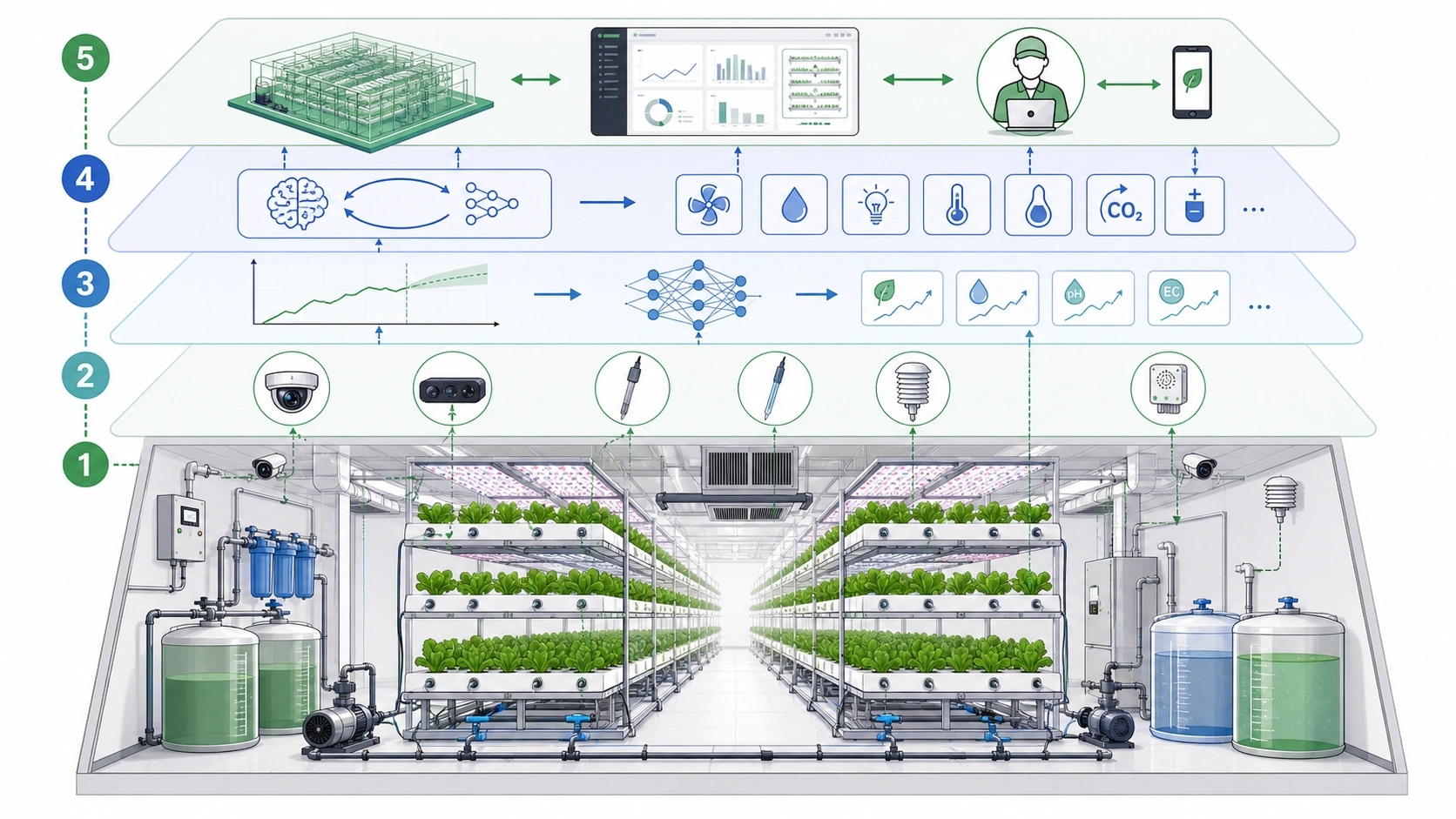
Figure 1. Multilayer AI technology stack for plant factories, connecting sensing, perception, prediction, decision-making, and operation.
3. Machine Vision and Deep Learning for Crop Monitoring
Machine vision is one of the most active areas of plant-factory AI. Compared with open-field agriculture, plant factories provide relatively stable backgrounds, lighting structures, camera positions, and crop arrangements. These conditions make them suitable for automated image analysis. However, plant-factory images still contain difficult problems such as leaf overlap, dense canopies, LED-induced color distortion, variable plant size, and occlusion in multilayer racks.
Tian et al. reviewed the application status and challenges of machine vision in plant factories and identified crop growth monitoring, stress detection, robot operation, and product quality inspection as major application areas [1]. Ojo and Zahid similarly showed that deep learning in controlled-environment agriculture has been applied to crop monitoring, stress detection, irrigation, microclimate prediction, energy-efficient controls, and crop growth prediction [2].
Early plant-factory vision studies often relied on manually designed image features. A notable transition appeared in the work of Nagano et al., who used optical-flow analysis and machine learning to predict lettuce growth from leaf movement [3]. This study was important because it treated plant growth as a dynamic process rather than a static image-measurement problem.
Recent studies increasingly use deep learning and multimodal sensing. Lin et al. proposed a multimodal deep-learning model for automatic lettuce fresh-weight estimation using RGB-D images [4]. Moon et al. applied deep neural networks to analyze the growth of plant-factory-grown lettuce using automated feature extraction [5]. Tan et al. proposed PosNet, which estimates lettuce fresh weight from oblique images rather than relying only on top-view images [6]. Kim et al. developed a machine-vision-based fresh-weight prediction system for butterhead lettuce in an industrial plant factory [7]. These studies show that plant-factory vision has moved from simple image analysis toward production-oriented, non-destructive crop measurement.
Stress and disorder detection are also important applications. Tip burn in lettuce is a representative physiological disorder in controlled environments. Hamidon and Ahamed used deep-learning models to detect tip-burn stress in indoor-grown lettuce [8], and Kumaratenna and Cho studied AI-based tipburn detection in plant-factory-grown lettuce [9]. More recent work has extended image-based diagnosis to nutrient-deficiency symptoms [10].
This trajectory is further supported by CNN, IoT-enabled AI, RGB-D fusion, 3D point-cloud completion, improved Mask R-CNN, plant-growth-model prediction, and multimodal-fusion studies for lettuce growth monitoring, fresh-weight estimation, seedling segmentation, and phenotype extraction in greenhouse, hydroponic, and plant-factory settings [20-22,25-29].
4. Nutrient-Solution Intelligence and Sensor Correction
Nutrient-solution management is a central but less visible part of plant-factory AI. Many plant factories use hydroponic systems, where crop growth depends on pH, electrical conductivity, dissolved oxygen, water temperature, and individual ion concentrations. Traditional nutrient management often relies on pH and EC, but these variables cannot fully describe the balance of individual ions. In closed hydroponic systems, plants absorb ions at different rates, which can cause ion imbalance even when EC appears normal.
Ion-selective electrodes can measure individual ions, but they are affected by ion interference, calibration drift, kinetic artifacts, and electrical artifacts. Therefore, nutrient-solution AI must address not only control decisions but also sensor reliability. Ban, Ryu, and Lee proposed a machine-learning method to remove ion interference effects from agricultural nutrient-solution measurements [11]. The study used machine learning to correct ISE data distorted by ion interference and suggested that the corrected data could be used in real time.
Nutrient solution is not only a sensing problem but also a nonlinear chemical system. Ban, Lee, and Ryu proposed an ordinary differential equation network model for nonlinear and complex agricultural nutrient-solution systems [12]. The model represented nutrient-solution reactions as differential equations and predicted ion concentrations and total dissolved solids. This approach is relevant to plant factories because closed hydroponic systems require repeated readjustment of nutrient composition, and empirical EC-based supplementation cannot predict the chemical consequences of control inputs.
Later work extended this direction to deep-learning-based artifact removal from ion-selective electrodes [13] and an automated nutrient-solution management system for smart farms and plant factories [14]. These studies indicate that nutrient intelligence has two roles in plant factories. First, it improves the reliability of chemical sensing. Second, it provides the foundation for model-based nutrient control. Beyond root-zone sensing, hyperspectral imaging and machine-vision studies have also estimated foliar nutrient concentrations and classified lettuce nutrient-deficiency symptoms, suggesting that nutrient intelligence can combine chemical sensors with image-based diagnosis [23,24].
For practical plant factories, AI-based phenotyping above the canopy and AI-based diagnosis below the root zone should be integrated rather than treated as separate systems. This is particularly important because visual symptoms often appear after physiological imbalance has already progressed, whereas nutrient-solution and sensor-level intelligence may allow earlier intervention. Figure 2 illustrates how sensing, prediction, and actuator control can be connected as a closed-loop AI operation system.
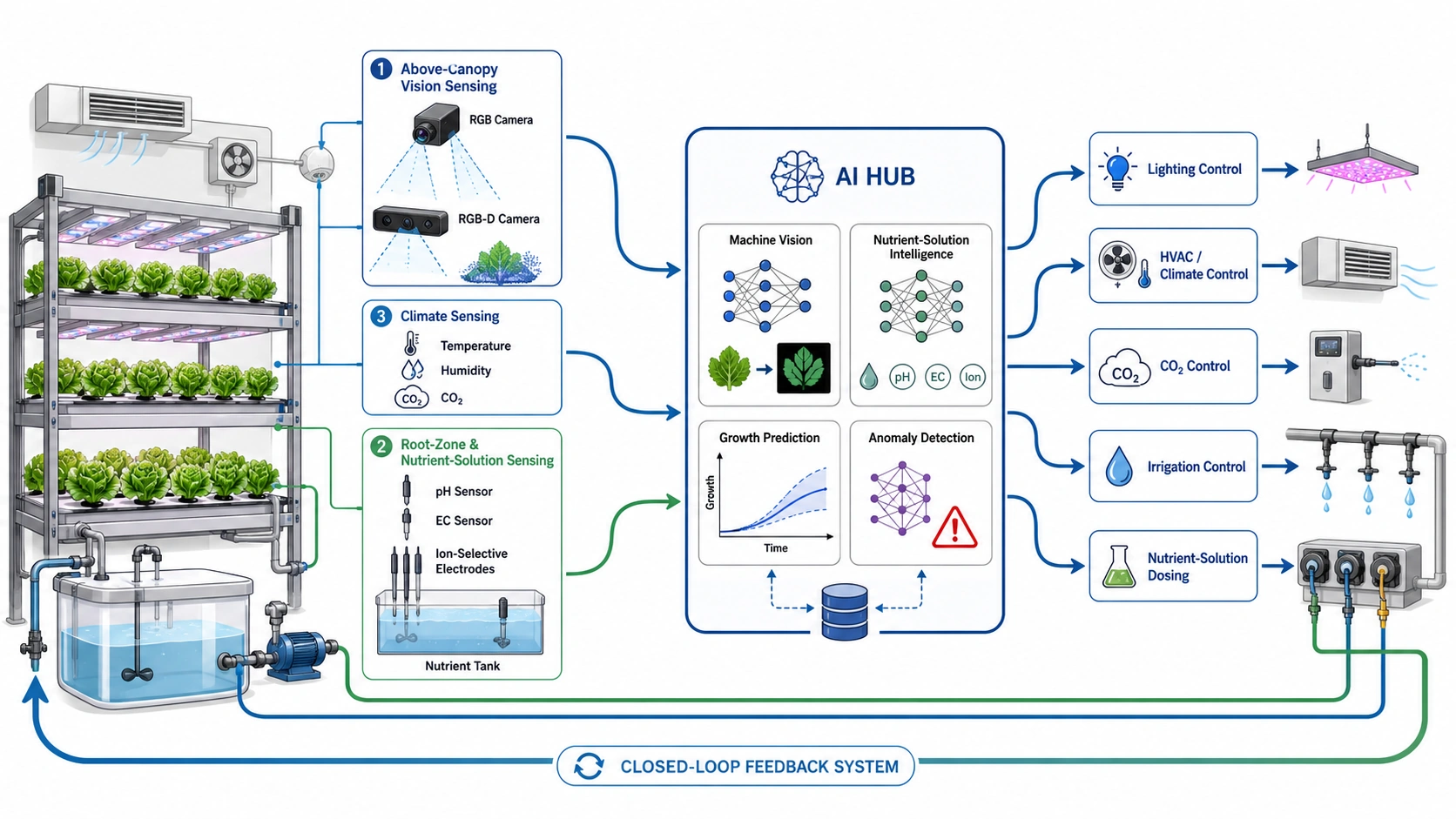
Figure 2. Closed-loop AI operation for plant factories, integrating above-canopy sensing, root-zone nutrient sensing, climate sensing, AI modules, and actuator control.
5. AI-Based Environmental Control
Environmental control in plant factories is a multivariable and nonlinear problem. Light, temperature, humidity, vapor pressure deficit, carbon dioxide, airflow, irrigation, and nutrient solution interact with one another. A control input that improves one objective may worsen another. For example, increased lighting may accelerate growth but also increase energy demand and thermal load. Therefore, plant-factory control requires predictive and adaptive methods rather than independent threshold rules.
Reinforcement learning is suitable for this type of problem because it can learn policies for long-term reward under complex system dynamics. Ban and Kim applied an actor-critic reinforcement-learning approach to a nonlinear, complex, black-boxed greenhouse system [15]. Although greenhouse systems are not identical to plant factories, the methodological problem is transferable: both involve multivariable environmental control, actuator side effects, and incomplete knowledge of system dynamics.
Future plant-factory control systems should combine reinforcement learning, crop-growth models, sensor uncertainty, and operational constraints. The goal should not be simply to maintain fixed setpoints, but to optimize crop growth, product quality, resource use, and production schedules simultaneously. In this sense, AI-based environmental control is a bridge between crop monitoring and autonomous plant-factory operation.
6. Digital Twins and Mixed-Reality Operation
Digital twins provide a framework for integrating sensors, crop models, facility states, and control logic into a virtual representation of a plant factory. In AI-based plant factories, digital twins can support monitoring, simulation, fault detection, remote operation, and decision-making. Unlike ordinary dashboards, digital twins can connect real-time data with predictive models and spatial interfaces.
Zhang et al. designed a digital twin system for multi-environmental-variable mapping in a plant factory [16]. Chen et al. proposed a five-dimensional digital-twin modeling method for plant-factory transplanters [17]. These studies show that digital twins are expanding from environmental visualization to equipment modeling and production-process integration.
A mixed-reality interface for a digital twin of a plant factory was proposed to make remote operation more intuitive [18]. In this approach, a real-time camera scene from the plant factory is combined with an interactive interface, allowing users to monitor and control remote facilities through an HMD or a 2D display. This direction is important because commercial plant factories require not only accurate models but also operator-centered interfaces. If digital twins are to become practical operating systems, they must connect AI predictions with human-understandable spatial information.
Digital twins can also connect the other AI layers discussed in this review. Machine-vision models can estimate crop status, nutrient models can estimate root-zone conditions, control models can simulate actuator strategies, and operator interfaces can present these results in an integrated environment. Therefore, digital twins are likely to become the operational core of future plant-factory AI. Figure 3 illustrates how digital twins and mixed-reality interfaces can connect physical plant factories, AI models, and remote operators.
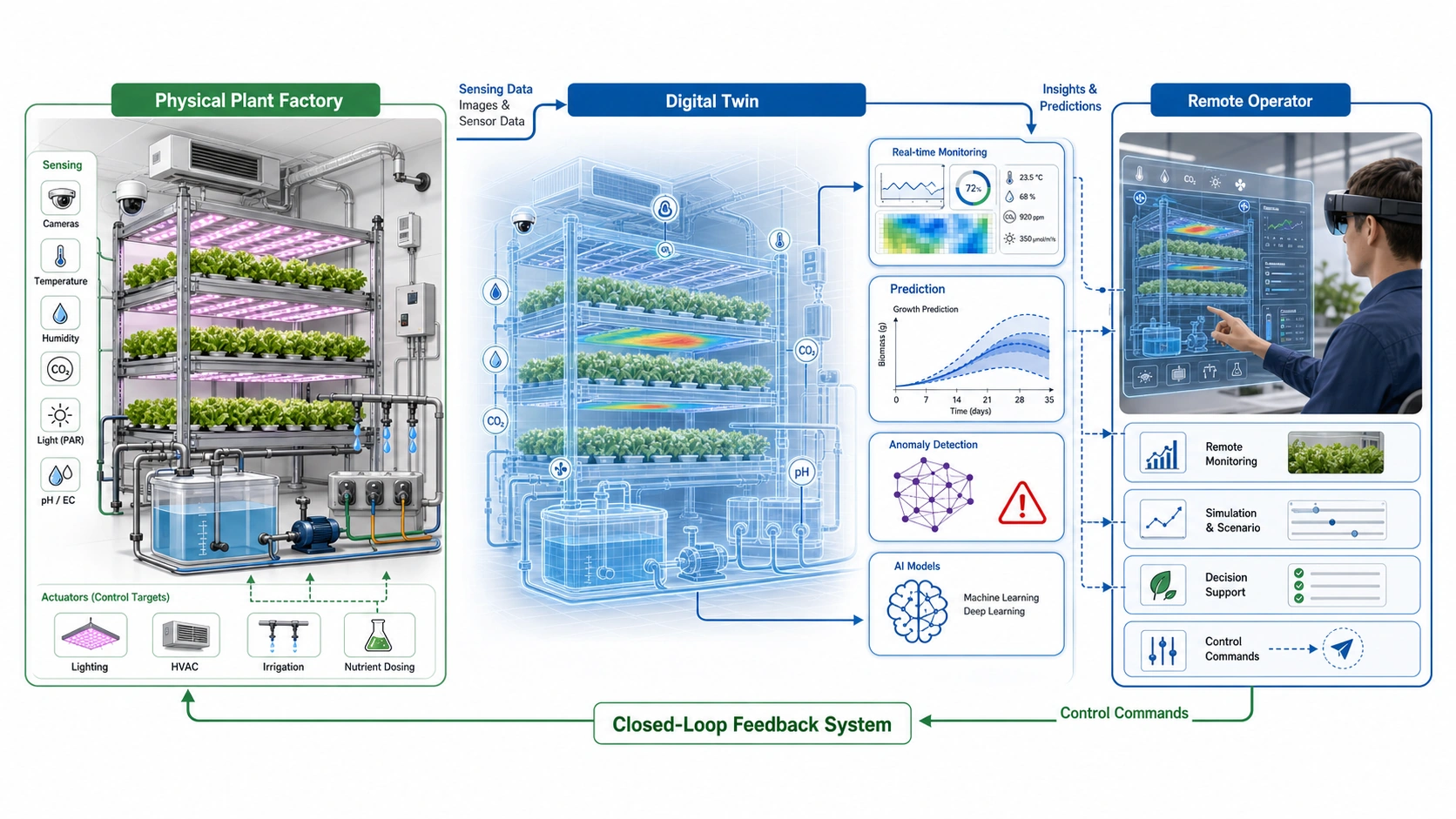
Figure 3. Digital-twin and mixed-reality interface for plant-factory AI, linking physical cultivation systems, virtual simulation, remote monitoring, and control commands.
7. Dataset-Driven Product Inspection
Plant-factory AI should include not only cultivation-stage monitoring but also product-level inspection. Commercial plant factories must grade, sort, measure, and package crops after harvest. This requires datasets designed for classification, segmentation, defect detection, and physical measurement.
The CongNaMul dataset provides an example of dataset-driven AI for factory-style crop-product inspection [19]. It was designed for advanced image processing of soybean sprouts and includes tasks such as quality classification, semantic segmentation, decomposition, and physical feature measurement. Although soybean sprouts are different from leafy vegetables commonly used in PFAL studies, they are highly relevant to automated crop production and industrial inspection. This dataset demonstrates how plant-factory AI can extend from growth monitoring to post-harvest quality assessment.
Dataset construction remains a major bottleneck in plant-factory AI. Models trained in one facility often fail in another because of differences in crop variety, camera position, LED spectrum, background, cultivation density, and growth stage. Therefore, future datasets should include multiple facilities, imaging conditions, cultivars, and annotation types. Without standardized datasets, plant-factory AI will remain difficult to compare and difficult to commercialize.
8. Challenges and Future Directions
The first challenge is generalization. Many AI models report good performance under controlled experimental conditions, but plant factories differ in hardware, lighting, crop spacing, sensor placement, and cultivation protocols. Future research should emphasize cross-facility validation, transfer learning, domain adaptation, and uncertainty estimation.
The second challenge is sensor reliability. AI models depend on sensor data, but plant-factory sensors are exposed to humidity, nutrient solution, electrical noise, drift, and contamination. ISE-related studies show that signal correction and artifact removal are not minor preprocessing steps but central requirements for intelligent nutrient management [11-14].
The third challenge is explainability. Deep-learning models can estimate fresh weight or detect disorders, but plant-factory operators need to understand why a disorder occurred and what action should be taken. Hybrid models that combine crop physiology, mechanistic equations, and machine learning may be more useful than purely black-box models.
The fourth challenge is closed-loop decision-making. Many current studies focus on monitoring: estimating fresh weight, detecting stress, or visualizing environmental variables. Fewer studies complete the loop by automatically adjusting environmental or nutrient conditions based on AI predictions. The next stage of plant-factory AI should connect sensing, prediction, control, and operator feedback.
The fifth challenge is energy-aware intelligence. Energy is not discussed here as a general plant-factory engineering topic, but it remains an important objective for AI control. Future control models should optimize biological output and resource cost together, rather than maximizing growth alone.
9. Conclusion
Over the last decade, AI technologies for plant factories have developed from simple image processing and rule-based automation into integrated intelligent systems. Machine vision and deep learning now support non-destructive estimation of growth, fresh weight, stress symptoms, and product quality. Nutrient-solution intelligence improves the reliability of ion sensing and enables model-based management of hydroponic systems. Reinforcement learning and hybrid control models provide a path toward adaptive environmental regulation. Digital twins and mixed-reality interfaces connect physical plant factories with virtual operating environments.
The central argument of this review is that plant-factory AI should be understood as a multilayer system rather than a single model category. Visual phenotyping, nutrient sensing, environmental control, digital twins, and product inspection must be integrated to make plant factories practically intelligent. The next stage of plant-factory AI will therefore not be defined by a single neural-network architecture, but by the integration of perception, chemical sensing, crop modeling, energy-aware control, and operator-centered digital twins. Future plant factories should be understood not merely as automated farms, but as AI-mediated biological manufacturing systems.
References
[1] Tian, Z.; Ma, W.; Yang, Q.; Duan, F. Application Status and Challenges of Machine Vision in Plant Factory-A Review. Information Processing in Agriculture, 2022, 9, 195-211. doi: 10.1016/j.inpa.2021.06.003.
[2] Ojo, M. O.; Zahid, A. Deep Learning in Controlled Environment Agriculture: A Review of Recent Advancements, Challenges and Prospects. Sensors, 2022, 22, 7965. doi: 10.3390/s22207965.
[3] Nagano, S.; Moriyuki, S.; Wakamori, K.; Mineno, H.; Fukuda, H. Leaf-Movement-Based Growth Prediction Model Using Optical Flow Analysis and Machine Learning in Plant Factory. Frontiers in Plant Science, 2019, 10, 227. doi: 10.3389/fpls.2019.00227.
[4] Lin, Z.; Fu, R.; Ren, G.; Zhong, R.; Ying, Y.; Lin, T. Automatic Monitoring of Lettuce Fresh Weight by Multi-Modal Fusion Based Deep Learning. Frontiers in Plant Science, 2022, 13, 980581. doi: 10.3389/fpls.2022.980581.
[5] Moon, T.; Choi, W.-J.; Jang, S.-H.; Choi, D.-S.; Oh, M.-M. Growth Analysis of Plant Factory-Grown Lettuce by Deep Neural Networks Based on Automated Feature Extraction. Horticulturae, 2022, 8, 1124. doi: 10.3390/horticulturae8121124.
[6] Tan, J.; Hou, J.; Xu, W.; Zheng, H.; Gu, S.; Zhou, Y.; Qi, L.; Ma, R. PosNet: Estimating Lettuce Fresh Weight in Plant Factory Based on Oblique Image. Computers and Electronics in Agriculture, 2023, 213, 108263. doi: 10.1016/j.compag.2023.108263.
[7] Kim, J. S. G.; Moon, S.; Park, J.; Kim, T.; Chung, S. Development of a Machine Vision-Based Weight Prediction System of Butterhead Lettuce Using Deep Learning Models for Industrial Plant Factory. Frontiers in Plant Science, 2024, 15, 1365266. doi: 10.3389/fpls.2024.1365266.
[8] Hamidon, M. H.; Ahamed, T. Detection of Tip-Burn Stress on Lettuce Grown in an Indoor Environment Using Deep Learning Algorithms. Sensors, 2022, 22, 7251. doi: 10.3390/s22197251.
[9] Kumaratenna, K. P. S.; Cho, Y. Y. Detection of Tipburn Stress on Lettuce Grown in a Plant Factory Using Artificial Intelligence Models. Horticultural Science and Technology, 2024, 42, 711-724.
[10] Xie, J.; et al. Exploring Nutrient Deficiencies in Lettuce Crops: Utilizing Advanced Multidimensional Image Analysis for Precision Diagnosis. Sensors, 2025, 25, 1957. doi: 10.3390/s25071957.
[11] Ban, B.; Ryu, D.; Lee, M. Machine Learning Approach to Remove Ion Interference Effect in Agricultural Nutrient Solutions. International Conference on Information and Communication Technology Convergence, 2019, 1156-1161. doi: 10.1109/ICTC46691.2019.8939812.
[12] Ban, B.; Lee, M.; Ryu, D. ODE Network Model for Nonlinear and Complex Agricultural Nutrient Solution System. International Conference on Information and Communication Technology Convergence, 2019, 996-1001. doi: 10.1109/ICTC46691.2019.8939946.
[13] Ban, B.; Ryu, D.; Lee, M. Deep Learning Method to Remove Chemical, Kinetic and Electric Artifacts on ISEs. International Conference on Information and Communication Technology Convergence, 2020, 1242-1246; Preprints 2020, 2020050381. doi: 10.20944/preprints202005.0381.v2.
[14] Ban, B.; Lee, J.; Ryu, D.; Lee, M.; Eom, T. D. Nutrient Solution Management System for Smart Farms and Plant Factory. International Conference on Information and Communication Technology Convergence, 2020, 1537-1542. doi: 10.1109/ICTC49870.2020.9289192.
[15] Ban, B.; Kim, S. Control of Nonlinear, Complex and Black-Boxed Greenhouse System with Reinforcement Learning. International Conference on Information and Communication Technology Convergence, 2017, 913-918. doi: 10.1109/ICTC.2017.8190813.
[16] Zhang, Z.; Zhu, Z.; Gao, G.; Qu, D.; Zhong, J.; Jia, D.; Du, X.; Yang, X.; Pan, S. Design and Research of Digital Twin System for Multi-Environmental Variable Mapping in Plant Factory. Computers and Electronics in Agriculture, 2023, 213, 108243. doi: 10.1016/j.compag.2023.108243.
[17] Chen, K.; Zhao, B.; Zhou, H.; Zhou, L.; Niu, K.; Jin, X.; Li, R.; Yuan, Y.; Zheng, Y. Digital Twins in Plant Factory: A Five-Dimensional Modeling Method for Plant Factory Transplanter Digital Twins. Agriculture, 2023, 13, 1336. doi: 10.3390/agriculture13071336.
[18] Ban, B. Mixed Reality Interface for Digital Twin of Plant Factory. arXiv, 2022, arXiv:2211.00597. doi: 10.48550/arXiv.2211.00597.
[19] Ban, B.; Ryu, D.; Hwang, S.-w. CongNaMul: A Dataset for Advanced Image Processing of Soybean Sprouts. International Conference on Information and Communication Technology Convergence, 2023, 1892-1897; arXiv:2308.15690.
[20] Zhang, L.; Xu, Z.; Xu, D.; Ma, J.; Chen, Y.; Fu, Z. Growth Monitoring of Greenhouse Lettuce Based on a Convolutional Neural Network. Horticulture Research, 2020, 7, 124. doi: 10.1038/s41438-020-00345-6.
[21] Chang, C.-L.; Chung, S.-C.; Fu, W.-L.; Huang, C.-C. Artificial Intelligence Approaches to Predict Growth, Harvest Day, and Quality of Lettuce (Lactuca sativa L.) in an IoT-Enabled Greenhouse System. Biosystems Engineering, 2021, 212, 77-105. doi: 10.1016/j.biosystemseng.2021.09.015.
[22] Lou, M.; Lu, J.; Wang, L.; Jiang, H.; Zhou, M. Growth Parameter Acquisition and Geometric Point Cloud Completion of Lettuce. Frontiers in Plant Science, 2022, 13, 947690. doi: 10.3389/fpls.2022.947690.
[23] Pandey, P.; Veazie, P.; Whipker, B. E.; Young, S. N. Predicting Foliar Nutrient Concentrations and Nutrient Deficiencies of Hydroponic Lettuce Using Hyperspectral Imaging. Biosystems Engineering, 2023, 230, 458-469. doi: 10.1016/j.biosystemseng.2023.05.005.
[24] Lu, J.; Peng, K.; Wang, Q.; Sun, C. Lettuce Plant Trace-Element-Deficiency Symptom Identification via Machine Vision Methods. Agriculture, 2023, 13, 1614. doi: 10.3390/agriculture13081614.
[25] Xu, D.; Chen, J.; Li, B.; Ma, J. Improving Lettuce Fresh Weight Estimation Accuracy through RGB-D Fusion. Agronomy, 2023, 13, 2617. doi: 10.3390/agronomy13102617.
[26] Ojo, M. O.; Zahid, A.; Masabni, J. G. Estimating Hydroponic Lettuce Phenotypic Parameters for Efficient Resource Allocation. Computers and Electronics in Agriculture, 2024, 218, 108642. doi: 10.1016/j.compag.2024.108642.
[27] Islam, S.; Reza, M. N.; Chowdhury, M.; Ahmed, S.; Lee, K.-H.; Ali, M.; Cho, Y. J.; Noh, D. H.; Chung, S.-O. Detection and Segmentation of Lettuce Seedlings from Seedling-Growing Tray Imagery Using an Improved Mask R-CNN Method. Smart Agricultural Technology, 2024, 8, 100455. doi: 10.1016/j.atech.2024.100455.
[28] Hosoda, Y.; Tada, T.; Goto, H. Lettuce Fresh Weight Prediction in a Plant Factory Using Plant Growth Models. IEEE Access, 2024, 12, 97226-97234. doi: 10.1109/ACCESS.2024.3423455.
[29] Hou, L.; Zhu, Y.; Wang, M.; Wei, N.; Dong, J.; Tao, Y.; Zhou, J.; Zhang, J. Multimodal Data Fusion for Precise Lettuce Phenotype Estimation Using Deep Learning Algorithms. Plants, 2024, 13, 3217. doi: 10.3390/plants13223217.
Citation
형식을 누르면 인용 정보가 복사됩니다.