Preprint · not peer-reviewed
When Post-Publication Modification Is Not Enough - A Case Study of Multi-Layer Scholarly Overlap and Delayed Retraction
2026
Abstract
Post-publication integrity concerns are often treated as problems of textual similarity, missing citation, or minor correctable error. However, some cases involve deeper forms of scholarly overlap that cannot be remedied through limited post-publication modification. This paper presents a case study of a post-publication complaint involving a 2022 preprint and a subsequent 2023 journal article that was later retracted. The official retraction notice states that an editorial investigation confirmed a high level of overlap between the subsequent article and the prior publication, including similarities in methodology, figures, layout, paper structure, and overall study topic, without appropriate acknowledgement and citation. The notice also states that concerns regarding the origins of the underlying data could not be satisfactorily resolved, leading the Editorial Board to lose confidence in the reliability and originality of the article. Using this case, the paper proposes a multi-layer overlap taxonomy and an editorial remedy framework. The central argument is that post-publication modification may be insufficient when the integrity concern extends beyond wording to methodology, visual materials, manuscript structure, attribution, and data provenance. In such cases, correction or citation addition cannot substitute for a full editorial investigation and, where appropriate, retraction.
Keywords: research integrity, plagiarism, retraction, post-publication correction, scholarly overlap, publication ethics, data provenance, editorial decision-making
1. Introduction
Plagiarism and scholarly overlap are often discussed as problems of copied sentences. This framing is too narrow. In contemporary scholarly publishing, overlap may occur not only at the level of wording, but also at the level of methods, figures, experimental materials, data origin, interface design, manuscript structure, and topic framing. When such overlap is discovered after publication, editors must decide whether the article can be corrected, whether an expression of concern is needed, or whether retraction is required to protect the scholarly record.
This paper analyzes a post-publication integrity case involving a prior preprint and a subsequent journal article that was later retracted. The paper uses the term “subsequent article” rather than accusatory terminology. This choice is deliberate. The analysis relies on document-level comparison, archived versions, and the official retraction notice, not on rhetorical characterization.
The official retraction notice states that the Editorial Office and Editorial Board investigated concerns raised after publication and confirmed a high level of overlap between the subsequent article and a prior publication. The notice specifies overlap in methodology, figures, layout, paper structure, and overall study topic, without appropriate acknowledgement and citation. It further states that concerns regarding the origins of the underlying data could not be satisfactorily resolved, resulting in loss of confidence in the reliability and originality of the article [2].
The case is analytically important because it includes evidence of limited post-publication modification before the eventual retraction. A post-complaint version of the subsequent article contained embedded author-to-editor text requesting changes, including figure replacement and the addition of the prior work as a reference. This evidence does not itself establish overlap. Rather, it supports the timeline showing that limited modification occurred before the later formal retraction.
This paper argues that when a case involves multi-layer overlap, post-publication modification is not enough. Adding a citation, replacing selected figures, or revising isolated text may be appropriate for limited errors, but such remedies cannot restore originality or reliability when overlap involves methodology, figures, layout, structure, topic framing, attribution, and data provenance.
The paper makes four contributions:
1. It proposes a multi-layer overlap taxonomy for post-publication integrity cases.
2. It reconstructs a case timeline from prior publication, complaint, limited modification, and eventual retraction.
3. It analyzes why post-publication modification was insufficient in this case.
4. It proposes an editorial remedy framework distinguishing correction, expression of concern, and retraction.
2. Case Background
2.1 Prior work
The prior work was a 2022 preprint titled “Mixed Reality Interface for Digital Twin of Plant Factory.” It proposed a mixed-reality interface architecture for plant-factory digital twins. The preprint described a system in which real-time camera scenes and IoT sensor data from a remote plant factory are processed into a mixed-reality environment, enabling users to monitor and control remote facilities through HMD or 2D-display interfaces. The preprint also described a system architecture involving plant-factory sensors and actuators, IoT nodes and servers, an interface server, a virtual environment, and frontend devices [1].
The prior work included visual materials showing a system-architecture diagram, a mixed-reality concept diagram, 360-degree plant-factory scene images, synthesized scenes, object-highlighting examples, and user-object interaction interfaces. The uploaded preprint version states that the full content was uploaded by the author on 29 October 2022.
2.2 Subsequent article and retraction
A subsequent article on a closely related plant-factory digital-twin interface topic was published in 2023. This paper does not cite the subsequent article as a normal scholarly source. Instead, the subsequent article is discussed through the official retraction notice and through archived case materials.
The official retraction notice states that the article was retracted after an investigation confirmed high overlap with the prior work. The notice identifies similarities in methodology, figures, layout, paper structure, and overall study topic, and states that appropriate acknowledgement and citation were absent. It also records unresolved concerns about the origins of the underlying data and states that the Editorial Board lost confidence in the reliability and originality of the article [2].
2.3 Post-complaint modification
After concerns were raised, the subsequent article appears to have undergone limited post-publication modification before eventual retraction. The author became aware of apparent modification partly through a third-party observation in a public academic-community discussion. This observation is not treated as primary evidence of overlap. It is treated as timeline evidence suggesting that limited modification was noticed before the eventual retraction.
A post-complaint version later obtained by the author contained embedded author-to-editor text inside the article PDF. The text requested help with two issues, including whether figures could still be modified and whether reference 47 could be amended. The embedded text then listed the prior work as an updated reference and stated that Figure 4 and Figure 8 could be replaced.
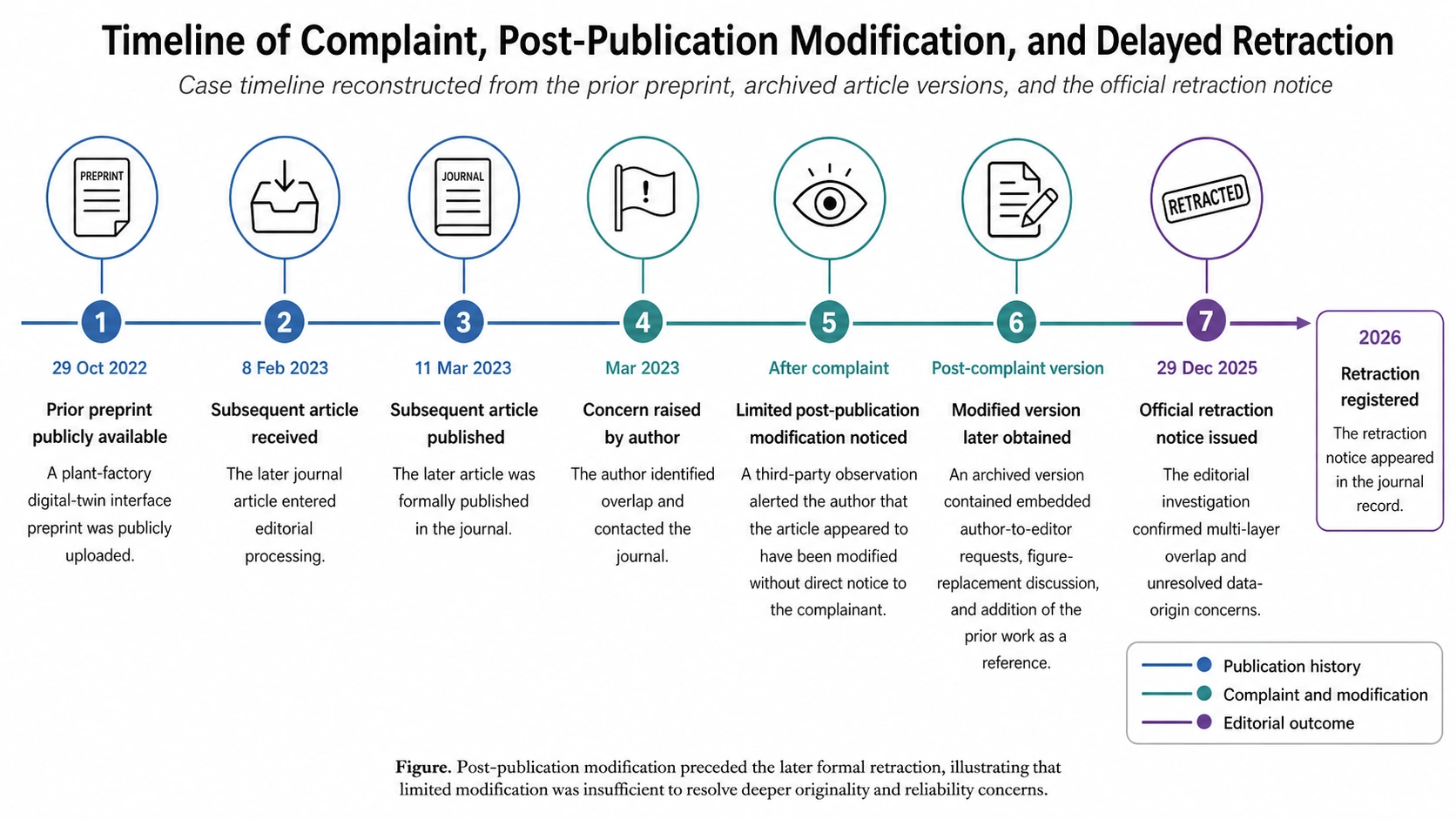
Figure 1. Timeline of complaint, post-publication modification, and delayed retraction.
This post-complaint version also included the prior work in the reference list as reference 47. In contrast, the earlier archived version’s reference list did not show the prior work in the same position; instead, reference 47 corresponded to a NeRF-related source. This sequence is central to the present analysis. It suggests that a limited post-publication remedy was attempted or prepared, but that the later editorial investigation still found the integrity concerns sufficiently serious to warrant retraction.
3. Evidence Sources and Method
This paper uses five types of evidence.
Table 1. Evidence sources used in the case analysis.
| Evidence type | Role in the analysis |
|---|---|
| Prior preprint | Establishes priority, topic, method, architecture, and visual materials. |
| Archived early version of the subsequent article | Supports document-level comparison before post-complaint modification. |
| Archived post-complaint version | Supports timeline evidence of limited modification and added reference. |
| Official retraction notice | Provides the highest-level editorial record of confirmed overlap and retraction basis. |
| Publication ethics policy | Provides policy basis for distinguishing correction and retraction. |
The case analysis proceeds in three steps. First, the prior work and the archived subsequent article versions were compared at the document level. The comparison focused on topic framing, methodology, figure structure, interface architecture, visual materials, manuscript structure, and attribution.
Second, the post-complaint version was analyzed to identify evidence of attempted or prepared modification. This included the embedded author-to-editor request, proposed figure replacements, and later inclusion of the prior work as a reference.
Third, the case was interpreted using the official retraction notice and publication ethics policy. The purpose was not to relitigate the case, but to derive a generalizable framework for post-publication remedy decisions.
4. Timeline
Table 2. Case timeline.
| Time | Event | Evidence |
|---|---|---|
| October 2022 | Prior preprint publicly available | Prior preprint record and uploaded PDF. |
| February–March 2023 | Subsequent article submitted, accepted, and published | Archived subsequent article PDF. |
| March 2023 | Author raised concerns after publication | Author-side correspondence and public documentation. |
| After complaint | A third-party observation alerted the author to apparent post-publication modification | Public academic-community observation; treated as timeline evidence only. |
| After complaint | Post-complaint PDF version contained embedded author-to-editor modification request and added prior work as reference 47 | Post-complaint archived PDF. |
| December 2025 | Official retraction notice published | Retraction notice. |
| 2026 issue | Retraction notice registered as Sustainability 18(1), article 320 | Retraction notice. |
This timeline matters because the case did not proceed directly from complaint to immediate retraction. Instead, limited post-publication modification appears to have preceded the later formal editorial decision. The case therefore illustrates why post-publication modification should not be treated as sufficient when deeper originality and reliability concerns remain unresolved.
5. Multi-Layer Overlap Taxonomy
This paper defines multi-layer scholarly overlap as overlap that extends beyond wording into multiple layers of scholarly contribution. The taxonomy below is derived from the case and from the categories explicitly mentioned in the retraction notice.
Table 3. Multi-layer overlap taxonomy.
| Layer | Definition | Case relevance |
|---|---|---|
| Textual overlap | Similar or near-identical wording, sentences, or paragraphs | View-synthesis and conclusion sections showed textual similarity. |
| Visual overlap | Similar figures, diagrams, images, visual layout, or visual data | Architecture diagrams, mixed-reality concept figures, interface images, and 360-degree scene images showed visual similarity. |
| Methodological overlap | Similar method, architecture, procedural logic, or system design | Both works described plant-factory digital-twin interface systems using camera scenes, IoT data, interface servers, virtual environments, and user interfaces. |
| Structural overlap | Similar manuscript organization, section flow, and argument progression | Both works followed similar progression from concept and system architecture to scene synthesis and interface interaction. |
| Topic-level overlap | Similar specific research problem and framing | Both works addressed plant-factory digital-twin interfaces using mixed/virtual scene interaction. |
| Attribution failure | Missing or inadequate acknowledgement of the prior work | Official notice states that appropriate acknowledgement and citation were absent. |
| Data-origin concern | Unresolved questions about the origins of underlying data or visual material | Official notice states that concerns about underlying data origins were not satisfactorily resolved. |
The key point is that the case was not limited to sentence-level similarity. The retraction notice itself identifies methodology, figures, layout, paper structure, and overall study topic. This makes the case a useful example of multi-layer scholarly overlap rather than ordinary citation omission [2].
6. Representative Case Analysis
6.1 System architecture overlap
The prior work presented a system architecture connecting the plant factory, IoT node, IoT server, interface server, virtual environment, and frontend devices. The subsequent article’s architecture figure likewise showed a physical system, cloud layer, virtual system, frontend, IoT node, IoT server, interface server, camera, sensors, actuators, and user devices.
This similarity is not merely a matter of graphic style. It reflects a shared system-design logic: camera and sensor data are transferred through IoT and interface layers to a virtual or mixed-reality environment, where users interact through frontend devices. Therefore, the overlap is best classified as both visual overlap and methodological overlap.
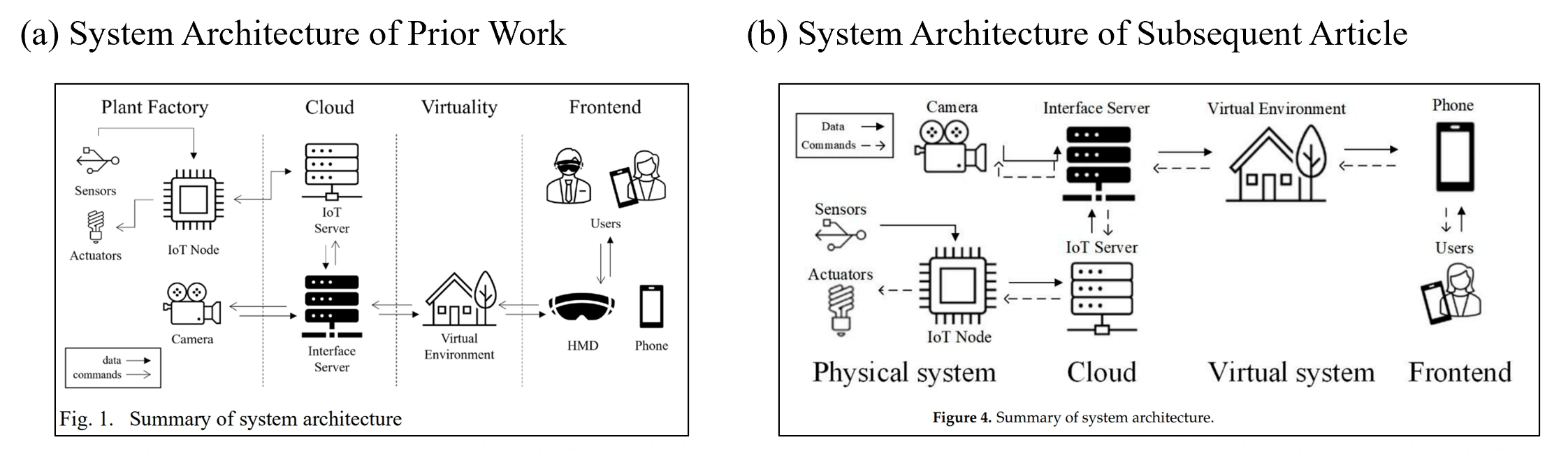
Figure 2. System Architecture Illustrations of 2 Papers
6.2 Scene acquisition and visual-data provenance
The prior work described 360-degree scene acquisition using a rotating single camera around a plant factory at 45-degree intervals, followed by processing using a pretrained Nerfies model to synthesize new scenes. The subsequent article contained a highly similar 3D scene processing description and presented 360-degree plant-factory scene images at similar angular intervals.
The visual comparison is especially notable because the lower edge of the 360-degree scene contains distinctive footwear visible in the prior work and also visible in the subsequent article’s 360-degree scene image. This detail is treated as evidence relevant to visual-data provenance, not as a personal identifier.
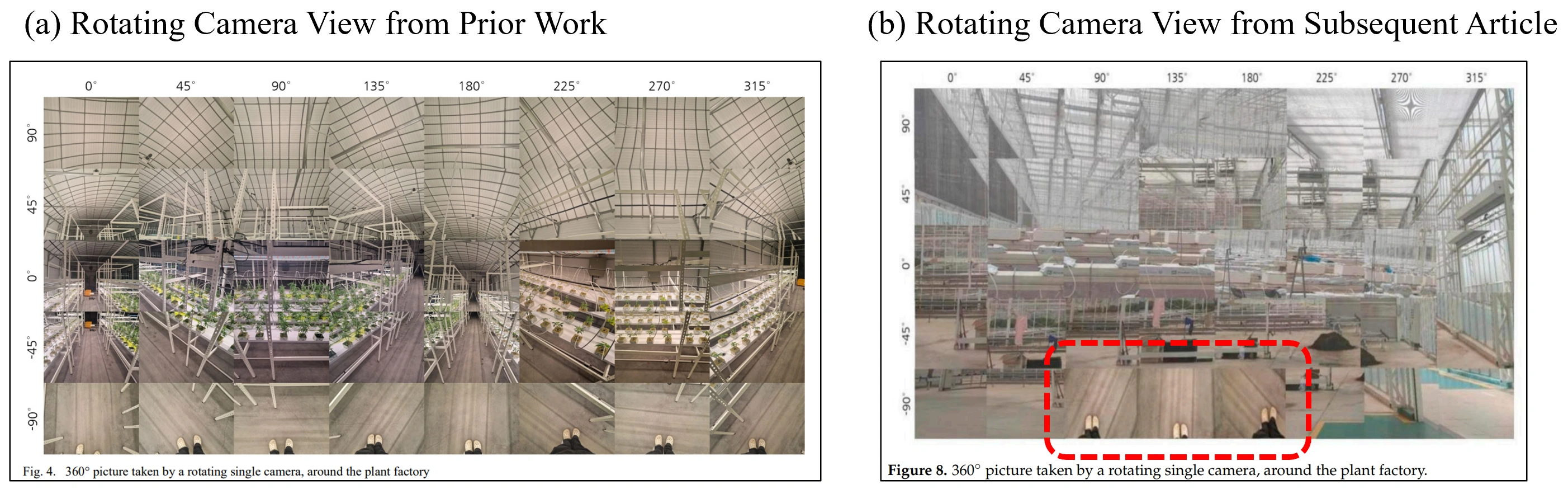
Figure 3. Representative 360-degree scene comparison. Distinctive visual elements are highlighted with red box.
6.3 Interaction-interface overlap
The prior work included object-selection, action-menu, and details-menu interfaces over plant-factory scene images. The subsequent article included analogous interface images showing an object-selection control panel, lighting control menu, and general control desk. This is best classified as visual and functional overlap. The concern is not that two systems used menus; interface menus are common. The concern is the combination of similar plant-factory scene backgrounds, mixed-reality overlay design, object-selection logic, and command-menu structure.
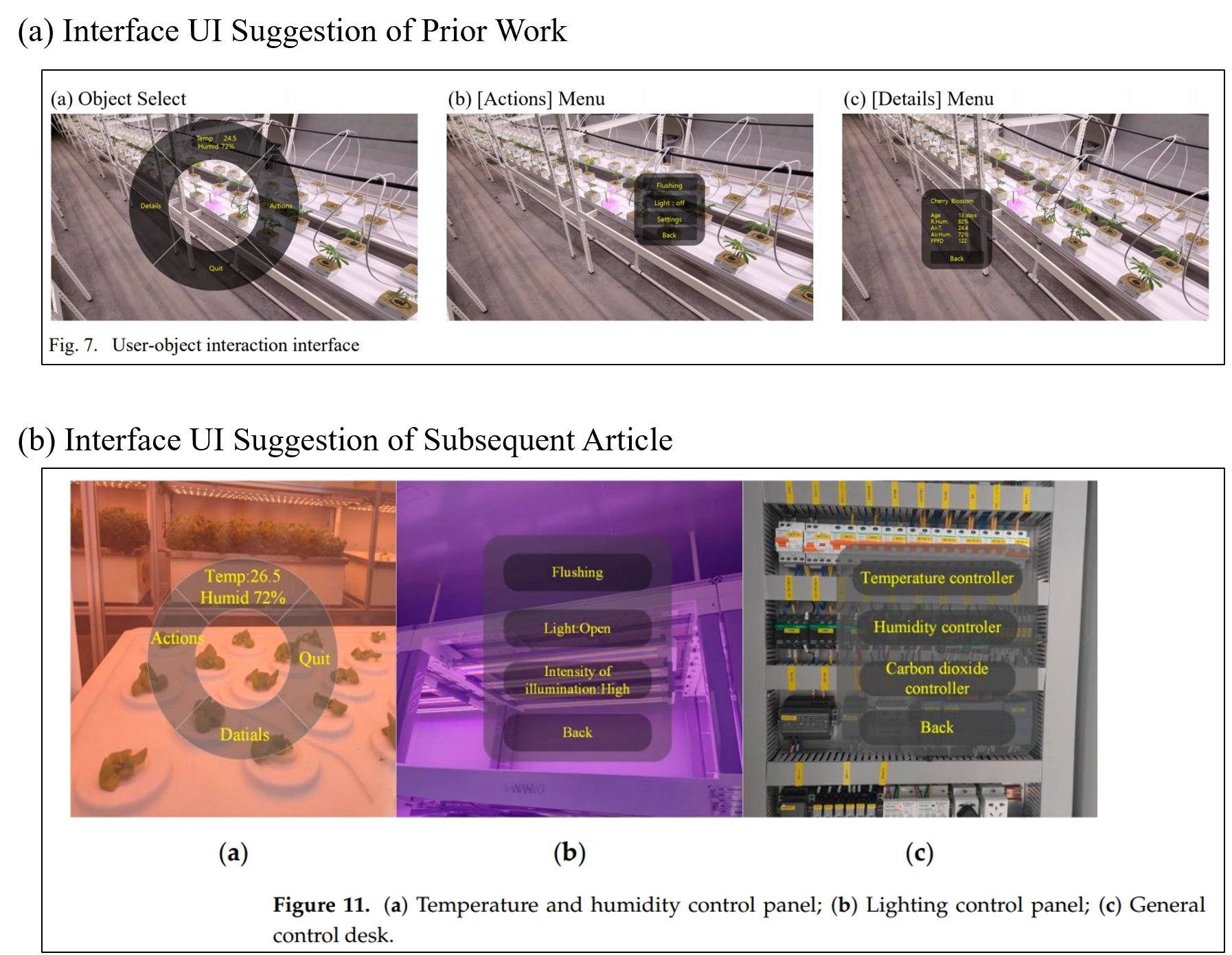
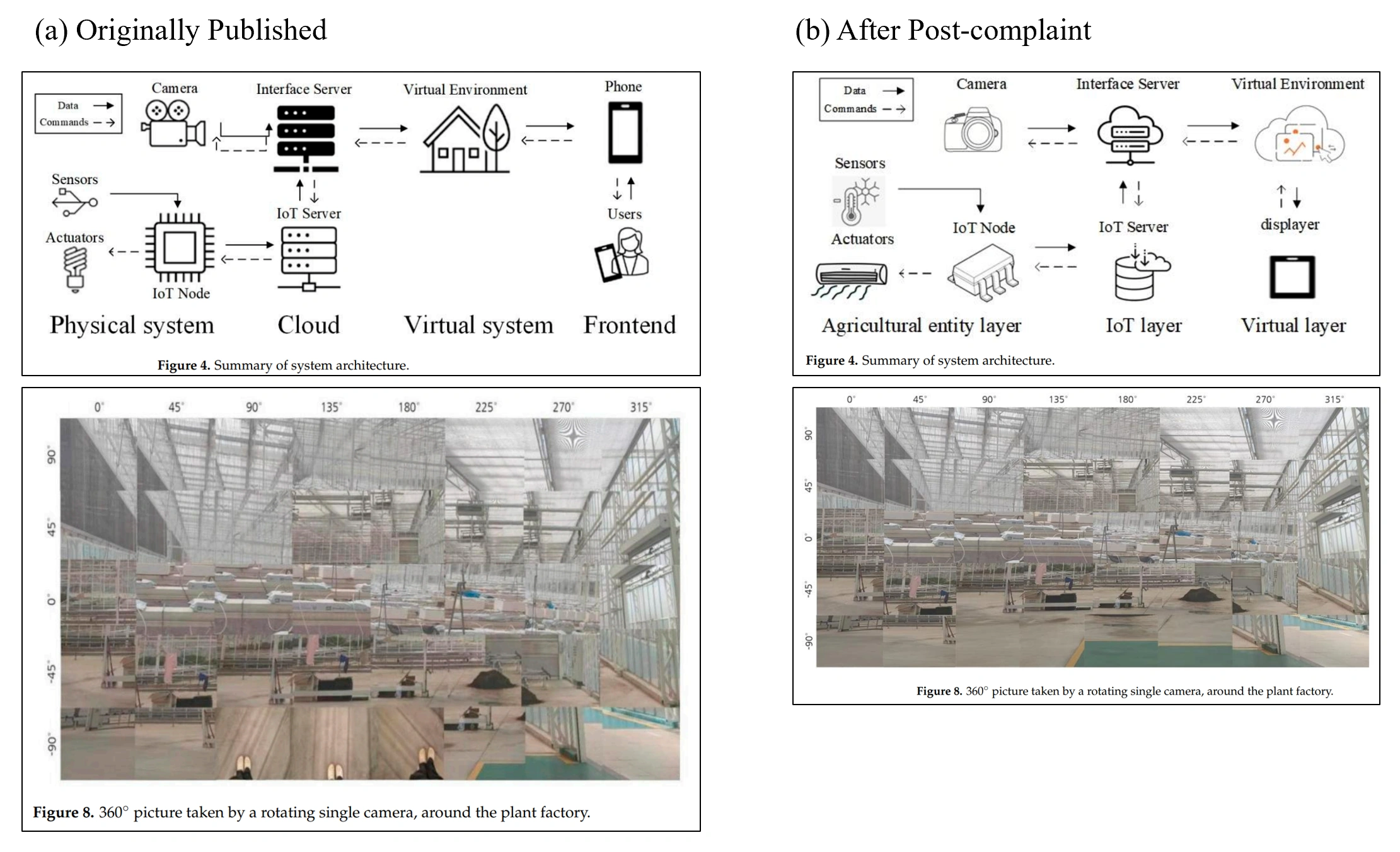
Figure 5. Post-complaint modification evidence.
6.4 Textual similarity
The prior work stated that a set of 360-degree camera scenes was taken with a rotating single camera around the plant factory at every 45 degrees, and that a pretrained Nerfies model processed the scenes to generate new scenes. The subsequent article contained a closely similar description of 360-degree camera scenes taken with a rotating single camera around the factory at 45-degree intervals and processed by a pretrained Nerfies model.
The conclusion sections also showed similarity in describing a 3D-like or 3D mixed-reality environment, visual information from cameras, sensory information from IoT nodes, intuitive processing, concise or easy UI, and remote control or monitoring.
These examples are useful because they demonstrate textual overlap. However, the paper’s central claim does not depend on textual overlap alone. The more important issue is that the textual overlap appears alongside visual, methodological, structural, attributional, and data-provenance concerns.
6.5 Modification after Author Complaint
The post-complaint version contained embedded author-to-editor text that appeared inside the article body. This text requested modification of a fund number, asked whether two figures could still be modified, asked whether reference 47 could be amended, listed the prior work as the updated reference, and stated that Figure 4 and Figure 8 could be replaced.
This is analytically important for two reasons. First, it supports the timeline that some form of post-publication modification was attempted or prepared after concerns were raised. Second, it illustrates why limited modification may be insufficient. The requested changes concerned figures and reference addition. Yet the later retraction notice still stated that the editorial investigation confirmed high overlap in methodology, figures, layout, paper structure, and overall study topic, along with unresolved concerns about underlying data origins.
7. Editorial Policy Basis
The editorial outcome should be interpreted through the retraction notice and the publication ethics policy cited by the notice.
MDPI’s research and publication ethics policy defines plagiarism broadly, including copying text, ideas, images, or data without credit to the original source. The same policy states that reused text must be quoted and cited, and that if a study’s design or a manuscript’s structure or language has been inspired by previous studies, those studies must be explicitly cited [3].
The policy also explains post-publication responses. MDPI distinguishes non-notified updates, minor corrections, major corrections, retractions, and expressions of concern. It states that papers may need to be retracted for reasons including gross ethical breaches, fabrication of data, large amounts of plagiarism, or other threats to the integrity of the scientific record. It also states that retracted articles should not be cited or used for further research because they cannot be relied upon [3].
This policy language directly supports the framing of this paper. The issue in multi-layer overlap is not limited to copied wording. It can extend to ideas, images, data, study design, manuscript structure, and data provenance. Therefore, post-publication modification is unlikely to be sufficient when the overlap affects the article’s originality and reliability at multiple levels.
COPE’s retraction guidance similarly frames retraction as a mechanism to correct the literature and preserve integrity, not as a punishment. It also requires retraction notices to clearly identify the retracted article and explain the reason for retraction [4].
8. Why Post-Publication Modification Was Not Enough
Post-publication modification may be appropriate when the problem is limited and correctable. Examples include typographical errors, limited citation omissions, minor production errors, or small wording problems that do not affect interpretation.
This case was different. The official notice identified high overlap in multiple layers of the article, and also reported unresolved concerns about underlying data origins. Once the concern includes reliability and originality, limited modification cannot restore trust.
Table 4. Why limited modification was insufficient in this case.
| Concern | Can citation addition fix it? | Can figure replacement fix it? | Why |
|---|---|---|---|
| Missing acknowledgement | Partially | No | Citation may address attribution but not necessarily originality. |
| Textual similarity | Partially | No | Text can be revised, but deeper overlap may remain. |
| Figure similarity | No | Partially | Replacing a figure may remove a visible symptom but not resolve data-origin questions. |
| Methodological overlap | No | No | The method itself may be the scholarly contribution. |
| Structural overlap | No | No | Manuscript organization may reflect dependence on prior work. |
| Topic-level overlap | No | No | The core framing may be appropriated. |
| Data-origin concern | No | No | Requires source verification, not wording change. |
| Reliability and originality loss | No | No | Requires full editorial investigation and possibly retraction. |
The case therefore supports the following principle: when overlap extends beyond wording to methodology, figures, layout, paper structure, topic framing, attribution, and data provenance, post-publication modification cannot substitute for a full editorial investigation and, where appropriate, retraction.
9. Editorial Remedy Framework
The case suggests a practical remedy framework for editors handling post-publication overlap complaints.
Table 5. Editorial remedy framework for scholarly overlap cases.
| Problem type | Correction | Expression of concern | Retraction |
|---|---|---|---|
| Typographical or production error | Appropriate | Usually unnecessary | Not appropriate |
| Minor citation omission | Often appropriate | Usually unnecessary | Usually not appropriate |
| Limited textual overlap | Sometimes appropriate | Possible during investigation | Depends on extent |
| Major unattributed text reuse | Often insufficient | Appropriate during investigation | Often appropriate |
| Unattributed reuse of ideas, images, or data | Often insufficient | Appropriate during investigation | Often appropriate |
| Study design or manuscript structure based on prior work without citation | Often insufficient | Appropriate during investigation | Often appropriate if central |
| Methodology, figures, layout, structure, and topic overlap | Insufficient | Appropriate during investigation | Strongly indicated |
| Unresolved data-origin concern | Insufficient | Appropriate during investigation | Strongly indicated |
| Multi-layer overlap plus unresolved data provenance | Insufficient | Interim measure only | Appropriate to protect scholarly record |
This framework does not imply that every similarity requires retraction. Similarity can be lawful, cited, derivative, or incidental. The decisive factors are extent, centrality, attribution, originality, reliability, and data provenance.
10. Author-Side Evidence Package
The case also suggests what authors should prepare when reporting post-publication overlap.
Table 6. Author-side evidence package for post-publication overlap complaints.
| Evidence | Purpose |
|---|---|
| Prior publication timestamp | Establish priority. |
| Subsequent publication timestamp | Establish sequence. |
| Topic-framing comparison | Show whether the research problem overlaps. |
| Methodology comparison | Show whether the core contribution overlaps. |
| Figure-by-figure comparison | Identify visual overlap. |
| Manuscript-structure comparison | Identify structural dependence. |
| Reference and acknowledgement check | Document attribution failure. |
| Data-origin questions | Identify reliability concerns. |
| Version-change evidence | Show post-publication modification. |
| Third-party observation | Corroborate timeline, not prove overlap. |
| Correspondence record | Reconstruct editorial handling. |
| Retraction or correction notice | Establish final editorial outcome. |
The evidence package should be factual and non-accusatory. The strongest author complaint is not emotional. It is documentary.
11. Discussion
11.1 Beyond sentence-level plagiarism
This case demonstrates why sentence-level similarity is insufficient as the sole standard for plagiarism or overlap assessment. Text can be paraphrased, translated, summarized, or modified after publication. However, overlap may persist in methods, figures, architecture, visual data, section flow, and topic framing.
The retraction notice’s explicit mention of methodology, figures, layout, paper structure, and overall study topic is therefore significant. It shows that the editorial issue was not merely copied wording. It concerned the originality and reliability of the article as a scholarly object [2].
11.2 Post-publication modification can obscure rather than resolve
Post-publication modification can be legitimate when transparent and proportionate. However, when a case involves multi-layer overlap, limited modification may obscure the underlying problem. Adding a citation may create the appearance of attribution, but it does not necessarily restore originality. Replacing figures may remove visible overlap, but it does not necessarily resolve data-origin concerns.
The post-complaint version in this case is important because it shows that limited modification was considered or attempted before the eventual retraction. The later retraction demonstrates that the deeper concerns remained unresolved.
11.3 Data provenance is central
The visual-data issue is not merely aesthetic. If a subsequent article contains visual materials that appear to derive from a prior work’s experimental or demonstration images, the question becomes one of data provenance. Who generated the images? Where were they taken? Were they authorized? Were they properly attributed? Are they evidence for the subsequent article’s own experiment?
The retraction notice states that concerns regarding the origins of the underlying data could not be satisfactorily resolved. This is a reliability issue, not only an originality issue [2].
11.4 Retraction delay matters
A delayed retraction can affect the scholarly record. A questionable article may remain accessible, be cited, be listed in publication records, or be used as evidence of scholarly output before the final editorial outcome. This does not mean that all investigations should be immediate or rushed. Investigations require care. But it does mean that journals should consider whether an expression of concern is appropriate while complex overlap and data-provenance issues are being investigated.
11.5 Tone matters in author complaints
The author’s strongest position is not anger but evidence. An author reporting overlap should avoid personal accusations and focus on document-level comparison: timestamps, figures, methods, structure, citations, data origin, and version changes. This paper follows that approach by referring to the disputed work as “the subsequent article” and relying on official editorial records.
12. Limitations
1. This is a single case study. It cannot estimate the prevalence of multi-layer scholarly overlap or delayed retraction.
2. Some timeline details rely on author-side records and archived versions. The official retraction notice is the highest-level evidence for the final editorial outcome, but the intermediate handling timeline may not be fully visible from public records.
3. This paper does not reproduce all comparison images in the main text. Some visual comparisons should be placed in the appendix to avoid turning the paper into a visual dossier.
4. The paper does not make legal claims. It analyzes publication ethics, editorial remedy, and scholarly-record integrity.
5. The paper does not cite the subsequent article as an ordinary scholarly source. This is intentional. The article is discussed through archived case evidence and the official retraction notice.
13. Conclusion
This case shows that post-publication modification is not enough when scholarly overlap is multi-layered.
If the problem is a minor citation omission, correction may be sufficient. If the problem is limited textual overlap, correction may sometimes be appropriate. But when the overlap extends to methodology, figures, layout, paper structure, overall topic, attribution, and data provenance, the concern is no longer a correctable wording issue. It concerns originality and reliability.
The official retraction notice in this case recorded overlap across multiple layers and unresolved concerns about underlying data origins. A post-complaint version of the subsequent article showed evidence of limited modification, including an added reference and proposed figure replacement. Yet the later retraction indicates that such modification did not resolve the deeper integrity concerns.
The lesson is clear: post-publication modification cannot substitute for editorial investigation when multi-layer overlap compromises originality and reliability.
Editorial policy should therefore distinguish minor correctable errors from deeper scholarly overlap. Authors should report such cases through evidence packages, and editors should evaluate not only copied sentences but also methods, figures, structure, attribution, and data provenance.
Ethics and Documentation Statement
This paper analyzes a public post-publication research-integrity case. The prior work and official retraction notice are public scholarly records. The subsequent article is not cited as an ordinary scholarly source; references to it are made through the official retraction notice and archived case evidence. Private correspondence, public-community usernames, and nonessential personal identifiers should be anonymized or summarized. Any visual evidence involving distinctive lower-edge footwear should be treated as evidence of visual-data provenance, not as personal identification.
AI-Use Statement
AI tools were used to assist drafting, organization, and language editing of this manuscript.
References
[1] B. Ban, “Mixed Reality Interface for Digital Twin of Plant Factory,” arXiv:2211.00597, 2022. https://doi.org/10.48550/arXiv.2211.00597
[2] J. Liu, L. Wang, Y. Wang, S. Xu, and Y. Liu, “RETRACTED: Liu et al. Research on the Interface of Sustainable Plant Factory Based on Digital Twin. Sustainability 2023, 15, 5010,” Sustainability, vol. 18, no. 1, article 320, 2026. https://doi.org/10.3390/su18010320
[3] MDPI, “Research and Publication Ethics,” accessed May 4, 2026. https://www.mdpi.com/ethics
[4] COPE Council, “COPE Retraction Guidelines,” Committee on Publication Ethics, 2025. https://publicationethics.org/guidance/guideline/retraction-guidelines
Citation
형식을 누르면 인용 정보가 복사됩니다.